Working…
Computational PROTAC Design

In Silico PROTAC Modeling

In silico PROTAC modeling is the computational effort to design, assemble, model, score, and prioritize degrader candidates before synthesis or experimental testing. Unlike conventional small-molecule docking, PROTAC modeling must reason about a ternary system: protein of interest, PROTAC, and E3 ligase.

Binary affinity is not enough. The productive intermediate is a POI-PROTAC-E3 ternary complex whose behavior can depend on linker geometry, cooperativity, protein-protein contacts, lysine accessibility, residence time, permeability, and cellular context. Computational methods help triage and explain candidates, but they do not guarantee degradation.

Ternary-complex focused Physics plus ML Feasibility before ranking Experiments still decide
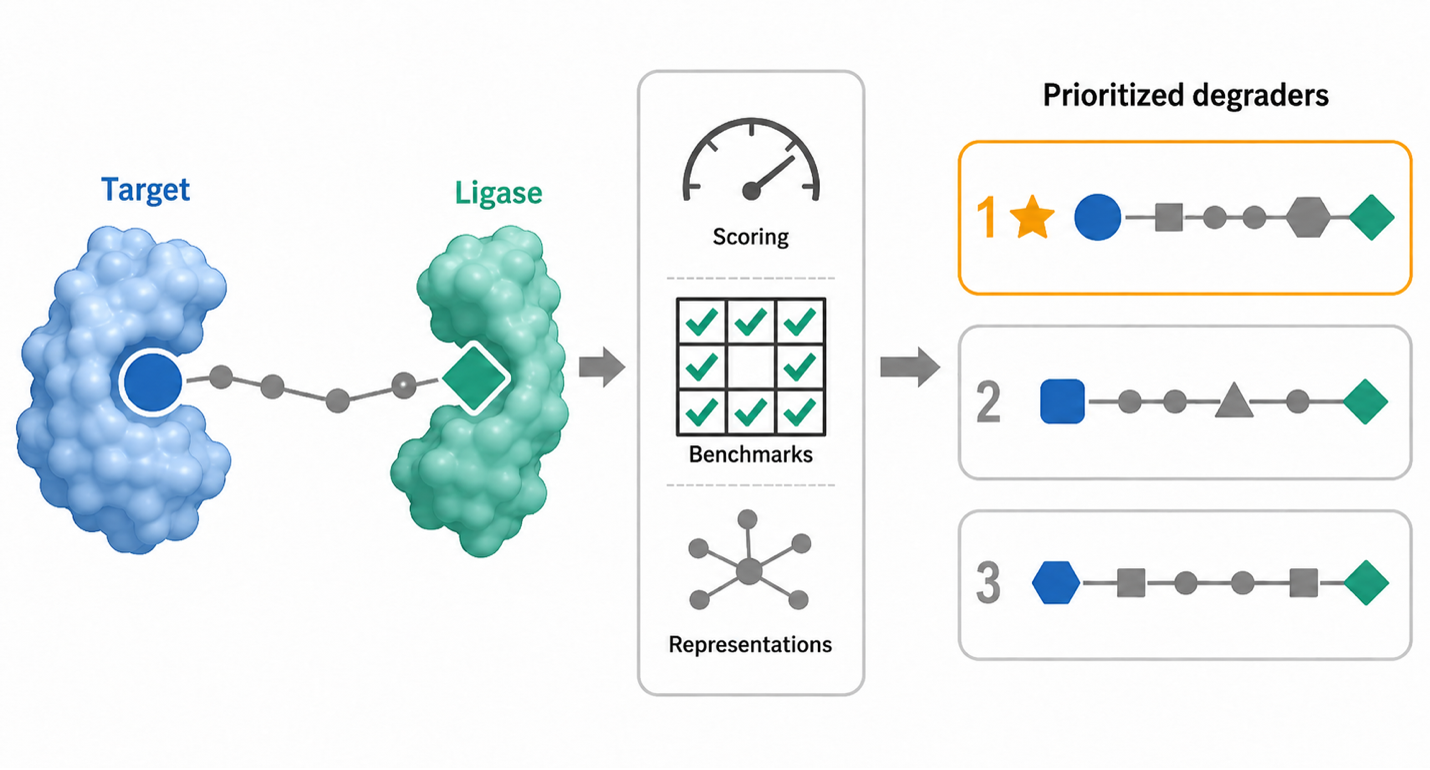
Overview graphic showing computational PROTAC design stages from candidate generation through geometric feasibility, ternary modeling, learned scoring, ensemble validation, and prioritization.
TOC graphic. Computational PROTAC design spans candidate generation, geometric feasibility, ternary modeling, learned scoring, ensemble validation, and prioritization. Figure from the Schurer Lab in silico PROTAC modeling perspective draft, used here as project-owned educational content.

Quick answer: what is in silico PROTAC modeling?

In silico PROTAC modeling uses computational methods to generate and evaluate degrader candidates by combining component selection, linker feasibility, ternary complex construction, pose scoring, molecular dynamics, machine learning prediction, and experimental-prioritization logic.

  1. Standardize warhead, linker, recruiter, and attachment-point representation.
  2. Build or enumerate candidate PROTACs.
  3. Check linker bridgeability and geometric feasibility.
  4. Generate ternary complex poses.
  5. Refine and score promising poses.
  6. Apply learned ranking or degradation prediction where appropriate.
  7. Use synthetic accessibility and property filters.
  8. Prioritize a small set for experimental degradation assays.

Why PROTAC modeling is different

The key design object is not just a ligand-protein complex but a ligand-induced protein-protein complex. A PROTAC can bind both proteins and still fail if the ternary orientation is unproductive, if the linker enforces strain, or if the resulting geometry does not support ubiquitination-competent presentation.

  • Flexible linkers create large conformational search spaces and entropic penalties.
  • Scoring is difficult because degradation depends on more than static pose geometry.
  • Relevant factors include cooperativity, surface lysines, ternary residence time, E3 expression, and assay context.
  • Negative examples such as “binds but does not degrade” are especially important and often underreported.
Reality check: in silico models are prioritization tools. The final test is biological degradation, not the docking score.
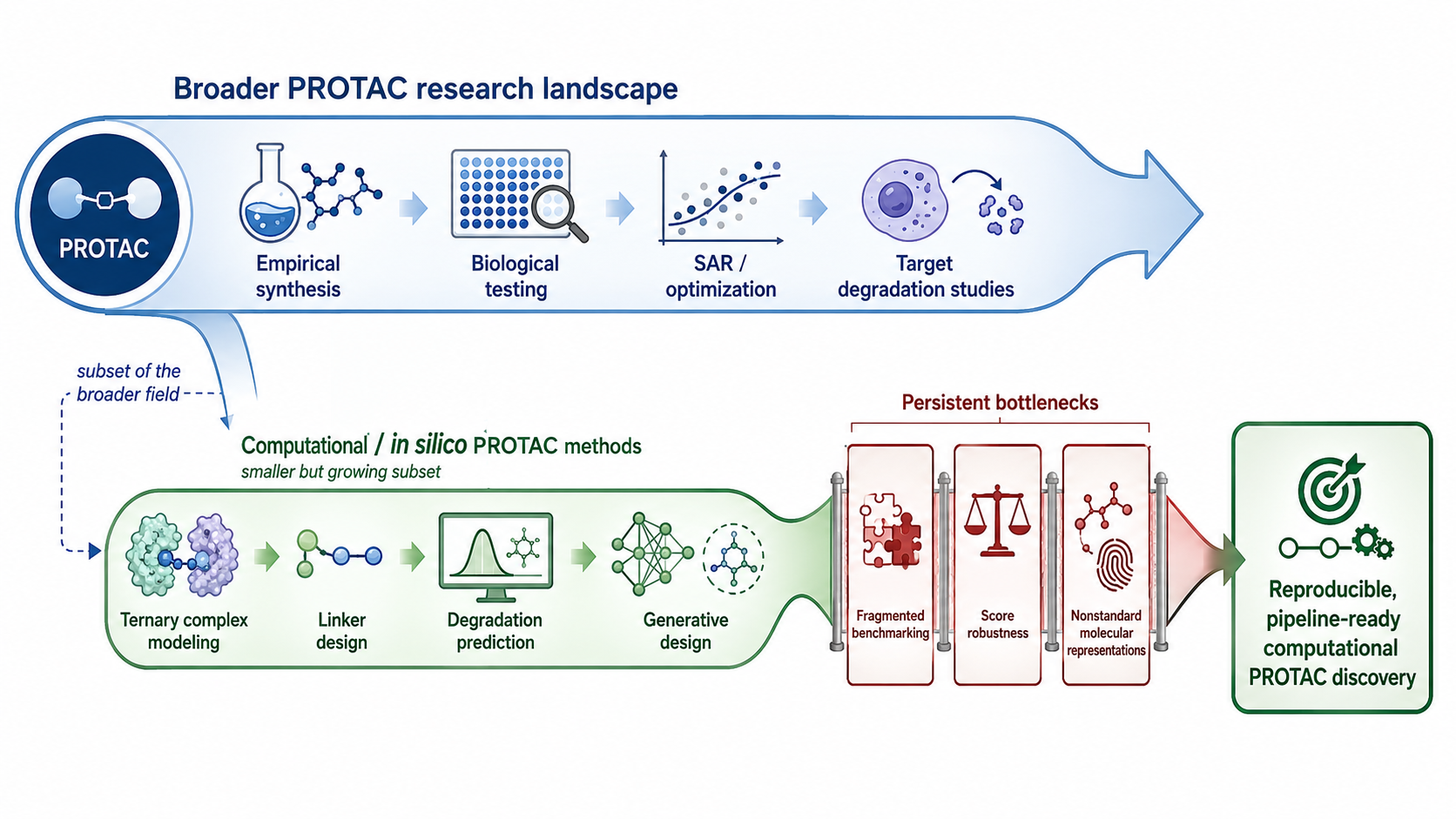
Conceptual overview showing that experimental PROTAC research is broad and mature while in silico workflows remain less standardized and more fragmented.
Figure 1. Conceptual overview of the computational PROTAC gap: experimental PROTAC research is mature and expanding, while reproducible in silico workflows remain less standardized. Figure from the Schurer Lab in silico PROTAC modeling perspective draft, used here as project-owned educational content.

The two main method families

Constraint-driven and physics-based methods

Best for: structure-first modeling, linker feasibility, mechanistic interpretation, ternary pose refinement, and explaining SAR.

Inputs: protein structures, ligand binding modes, anchor atoms, linker structures, and explicit geometric constraints.

Outputs: ternary poses, bridgeability checks, energy or stability layers, and ensemble behavior.

Risks: sampling cost, scoring sensitivity, brittle anchors, and incomplete handling of flexibility.

Data-driven and AI/ML methods

Best for: rapid triage, degradation prediction, pose re-ranking, candidate generation, and large-library prioritization.

Inputs: chemical structures, protein sequences or structures, assay labels, generated poses, and descriptors.

Outputs: degradation probability, pose viability, generated linkers, synthetic feasibility, and activity predictions.

Risks: dataset bias, weak out-of-domain generalization, limited interpretability, and dependence on training-data quality.

Practical takeaway: the strongest workflows usually combine both. Physics helps with feasibility and interpretability, while machine learning helps with throughput and prioritization.

Constraint-driven docking and PRosettaC

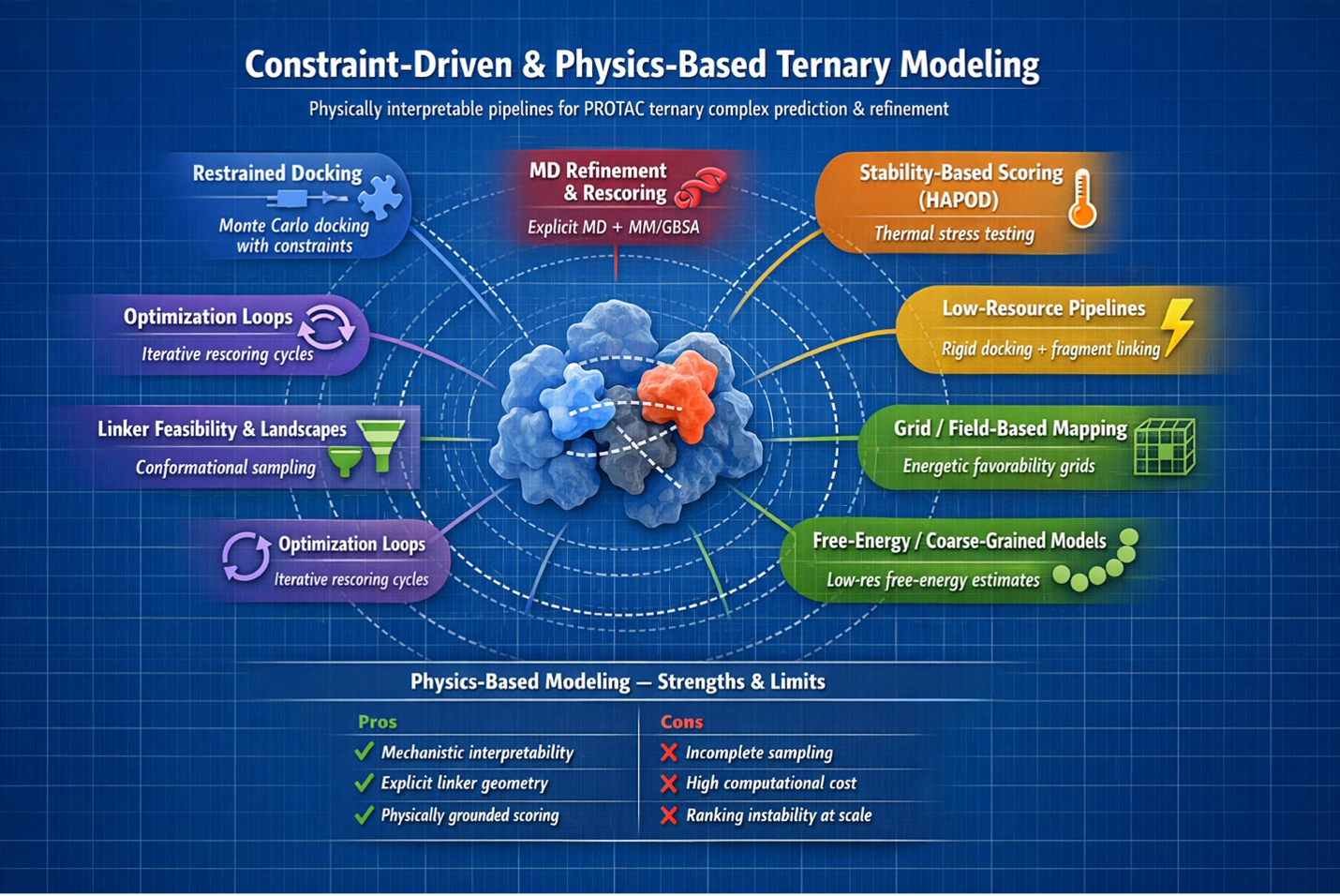
Landscape of constraint-driven and physics-based computational PROTAC methods including restrained docking, PRosettaC-style workflows, molecular dynamics refinement, HAPOD, DegraderTCM, energy landscapes, and field-based methods.
Figure 2. Constraint-driven and physics-based strategies for PROTAC ternary complex modeling, including restrained docking, PRosettaC-style workflows, MD refinement, HAPOD, DegraderTCM, energy landscapes, and field/grid methods. Figure from the Schurer Lab in silico PROTAC modeling perspective draft, used here as project-owned educational content.

Physics-based workflows treat the degrader as a real geometric object instead of a loose protein-complex prompt. They are most useful when you know the warhead pose, recruiter pose, and plausible attachment atoms well enough to enforce bridgeability and interpret failures.

Restrained docking and geometry-guided assembly

Early ternary docking and PRosettaC-style workflows use anchor atoms, distance restraints, and linker-compatible search to keep the pose space chemically meaningful.

Molecular dynamics and end-point rescoring

MD can relax poses, reveal instability, and add MM/GBSA-style rescoring as one interpretive layer rather than a final truth metric.

Dynamic stability scoring

HAPOD-style heating-accelerated pose departure stress-tests whether a pose persists under perturbation instead of only scoring a minimized snapshot.

Efficient ternary construction

DegraderTCM-style lower-cost pipelines support larger screens by trading structural nuance for speed and tractability.

Linker feasibility and energy landscapes

Bridgeability, cyclic-coordinate linker placement, and solvation or energy-landscape mapping help identify protein orientations that a real linker can actually span.

Coarse-grained and free-energy cooperativity

These methods prioritize interpretability, trend-mapping, and linker-length or shape reasoning over atomistic precision.

Optimization loops over pose parameters

BOTCP-style Bayesian optimization explores difficult pose spaces iteratively instead of relying on one docking run.

Grid-based and field-based ensemble scoring

SILCS-xTAC-style strategies map favorable linker and interaction regions across ensembles to score geometric and energetic complementarity.

Strengths

Mechanistic interpretability, explicit geometric feasibility, direct connection between linker and ternary pose, and usefulness for explaining SAR and failures.

Limitations

Sampling cost, force-field sensitivity, incomplete flexibility, limited transferability across targets or E3 ligases, and no guarantee that static stability means cellular degradation.

Machine learning for PROTAC degradation prediction

Data-driven workflows shift the emphasis from explicit geometric construction to learned prediction, ranking, or generation. They can be extremely useful for throughput, but they inherit the quality, coverage, and biases of the data used to train them.

Ternary structure prediction

AlphaFold or AlphaFold3-style attempts can propose protein arrangements, while DeepTernary-style SE(3)-equivariant models aim to predict ternary geometry directly.

Protein degradability and target tractability

MAPD-style models ask whether a target is intrinsically suitable for degradation, which is a target-level question rather than a candidate-PROTAC question.

Degradation efficacy prediction

DeepPROTACs and DegradeMaster-style models predict degradation outcomes from molecular, protein, and sometimes 3D features, but remain sensitive to assay context and domain shift.

Pose viability scoring and re-ranking

ET-PROTACs and PROTACable-style pipelines can re-rank ternary poses or connect docking outputs to learned structure-activity scoring.

Generative linker and degrader design

PROTAC-Invent, ProLinker-Generator, DAD-PROTAC, DiffPROTAC-like, and graph-based models can propose new chemistry but still need feasibility and validation filters.

Feasibility filters beyond activity

DeepPSA-style synthetic accessibility, property filters, and developability proxies help prevent large-scale generative outputs from becoming chemically unrealistic dead ends.

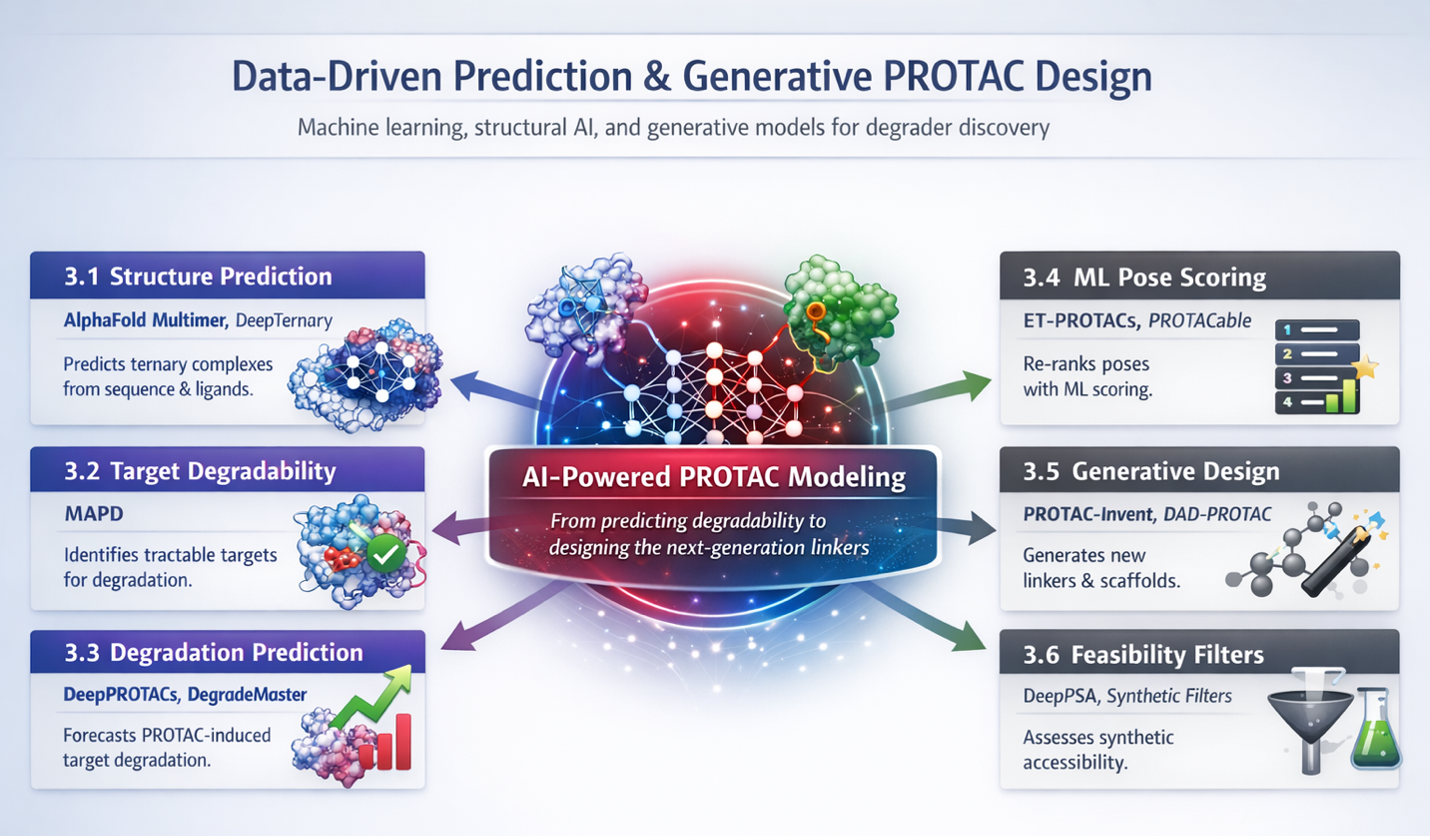
Landscape of data-driven PROTAC modeling methods covering ternary structure prediction, degradation prediction, pose re-ranking, generative design, and feasibility filters.
Figure 3. Data-driven prediction and generative design landscape for PROTAC discovery, covering ternary structure prediction, degradation prediction, pose re-ranking, generative design, and feasibility filters. Figure from the Schurer Lab in silico PROTAC modeling perspective draft, used here as project-owned educational content.
Strengths

High throughput, ability to learn patterns from assay and structure data, usefulness for prioritizing large enumerations, and capacity to propose new chemistry.

Limitations

Dataset bias, limited negatives, out-of-domain generalization risk, lower interpretability, and strong dependence on molecular-representation consistency.

Representative methods table

This table is a field map, not a ranking. The best method depends on the design question, available structures, throughput needs, and validation plan.

Year Method Where It Helps Major Limitation
2019 In silico ternary docking Early Monte Carlo plus protein-protein docking workflows showed that ternary pose generation was feasible and useful for initial geometry exploration. Recovered some near-native poses, but scoring produced many false positives and was not robust enough for confident ranking.
2020 PRosettaC Anchor-constrained Rosetta docking improves geometry-aware ternary construction and supports rational linker SAR interpretation. Needs reliable anchor definitions and prior structural knowledge; performance falls when those assumptions are wrong.
2021 MD-refined ternary modeling Rosetta or docking poses can be relaxed in explicit solvent, then inspected with MM/GBSA-like rescoring and cooperativity analysis. Computationally expensive and still sensitive to imperfect scoring functions.
2022 HAPOD scoring Stress-tests pose persistence with heating-accelerated MD instead of trusting one minimized snapshot. Requires repeated MD runs and can be force-field sensitive.
2022 MAPD Target-level degradability or tractability prediction helps decide whether a protein is a plausible degradation candidate at all. Not candidate-PROTAC-specific; it scores target biology more than degrader chemistry.
2022 DeepPROTACs Supervised degradation prediction can triage candidate molecules from molecular and protein features. Outcome quality depends heavily on training labels, assay context, and domain coverage.
2022 Graph-based generative models Can propose new degraders or optimize candidate chemistry across large design spaces. Generated outputs are only as good as the predictive model and constraints guiding them.
2023 Coarse-grained cooperativity Useful for understanding linker-length and protein-shape trends in ternary cooperativity. Interpretive rather than atomistically precise for a specific medicinal-chemistry decision.
2023 Energy landscape mapping CCD-style linker placement and energy or solvation landscapes reveal which protein orientations are physically bridgeable. Provides thermodynamic understanding but is not a standalone docking engine.
2023 PROTAC-Invent 3D generative linker design expands beyond empirical linker sets and proposes new bridge chemotypes. Generated linkers still need structure, property, and activity validation.
2023 BOTCP Bayesian optimization over pose parameters helps when initial ternary docking is ambiguous. Search and scoring can still miss the correct pose even after iterative refinement.
2024 DegraderTCM Lower-resource ternary construction supports broader screens when exhaustive sampling is too expensive. Speed comes at the cost of structural nuance and subtle rearrangement capture.
2024 PROTACable Integrates structure generation and learned activity prediction into a more end-to-end pipeline. Still depends on structural templates and model retraining for new target classes.
2024 AlphaFold-style ternary adaptations Can produce fully automated protein-complex hypotheses with minimal manual setup. Often cannot enforce actual PROTAC geometry and may misorient complexes or overtrust accessory interfaces.
2025 DeepTernary SE(3)-equivariant ternary structure prediction aims to generate 3D ternary complexes directly from proteins and degrader inputs. Needs curated structural training data and may weaken on novel targets, E3 ligases, or scaffolds.
2025 DegradeMaster Semi-supervised E(3)-equivariant degradation prediction adds geometry-aware features to outcome models. Complex training setup and ongoing dependence on curated degradation assay datasets.
2025 ProLinker-Generator Transformer-style linker generation expands linker chemical space with high novelty and validity. Generated linkers still require downstream feasibility, docking, and property filtering.
2025 DAD-PROTAC Diffusion-style generation adapts general molecule models toward large PROTAC-like linker chemistry. Heavier computation and sensitivity to how domain adaptation is calibrated.
2025 ET-PROTACs Cross-modal learned scoring helps re-rank docking ensembles by pose viability or complex stability. It scores existing poses rather than generating them and depends strongly on input-pose quality.
2026 SILCS-xTAC Grid-based ensemble scoring captures geometric and energetic complementarity across ternary ensembles. Score transferability across target, E3, and linker classes still needs broad validation.
2026 SE(3)-PROTACs Geometry-aware transformer models extend degradation prediction with 3D molecular graphs and protein context. Performance still depends on curated labels and may fall under harder out-of-domain evaluation splits.

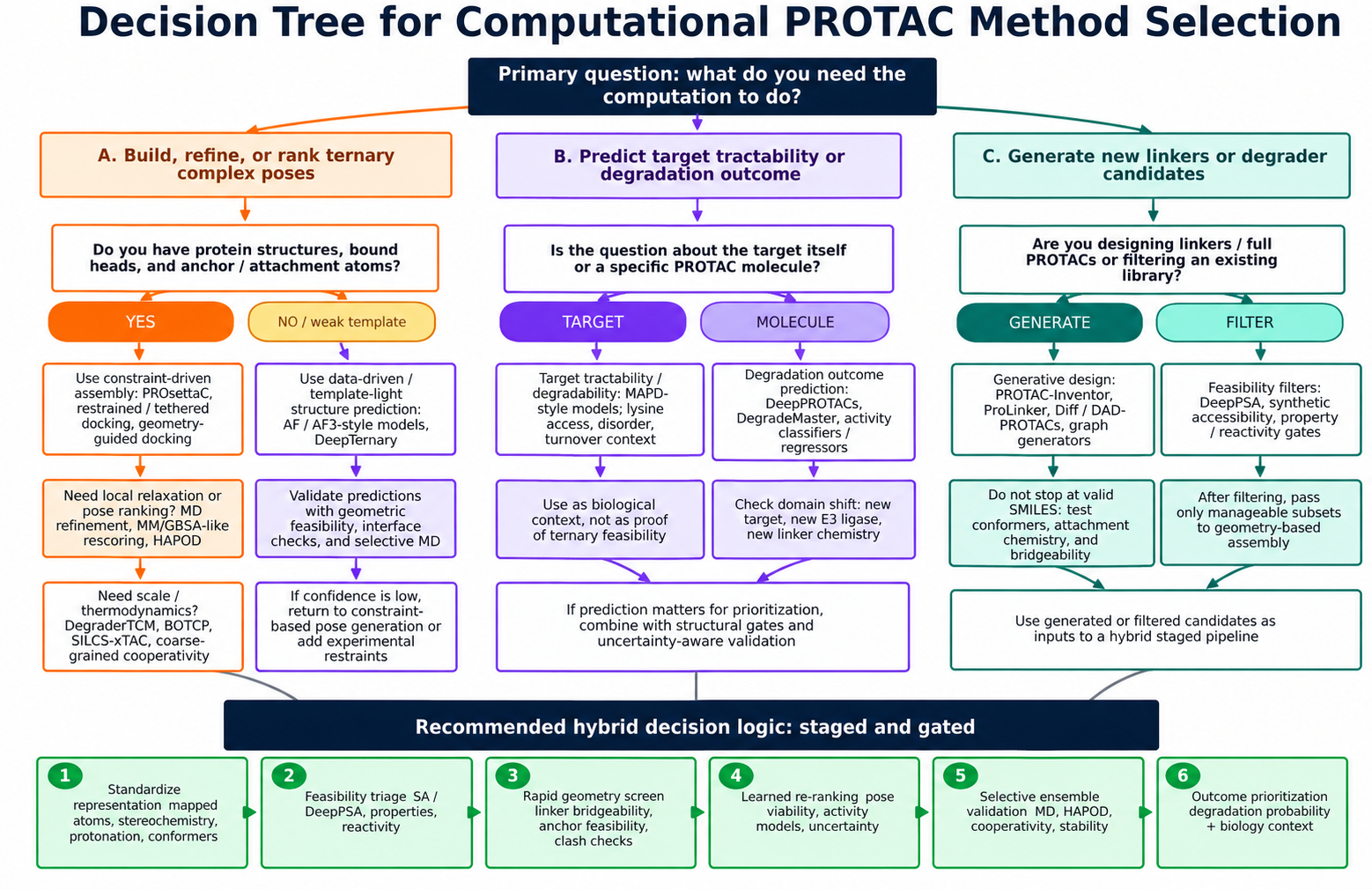
Practical decision tree: which method should I use?

Decision tree for selecting computational PROTAC methods based on whether the goal is pose generation, outcome prediction, generative design, or staged hybrid prioritization.
Figure 4. Decision tree for selecting computational PROTAC methods based on whether the goal is pose generation, outcome prediction, generative design, or staged hybrid prioritization. Figure from the Schurer Lab in silico PROTAC modeling perspective draft, used here as project-owned educational content.
  • Build ternary complex poses: use restrained docking, PRosettaC, DegraderTCM, SILCS-xTAC, or DeepTernary depending on structure availability and throughput needs.
  • Check linker feasibility: use bridgeability checks, PRosettaC-style workflows, or linker and energy-landscape methods.
  • Refine a small candidate set: use MD relaxation, HAPOD-style dynamic scoring, or selective ensemble validation.
  • Predict whether a target is degradable: use MAPD-style target tractability models plus biology review.
  • Predict whether a candidate will degrade: use DeepPROTACs, DegradeMaster, or related learned predictors where the domain fits.
  • Generate new linkers or degraders: use PROTAC-Invent, ProLinker-Generator, diffusion, or graph-based generators, then filter heavily.
  • Prepare reproducible inputs: use PROTAC Builder to standardize components, attachment points, linker candidates, and export paths.
Preparation

Start with PROTAC Builder

Standardize warheads, recruiters, attachment atoms, and linker candidates before heavier modeling.

Launch builder
Reporting

Review benchmarking guidance

Use reporting and evaluation standards before trusting method comparisons.

Open benchmarking
Handoff

Export to downstream modeling

Move prioritized candidates into restrained docking, MD, or learned re-ranking workflows.

Open downstream modeling

Hybrid PROTAC modeling workflows

  1. Standardize inputs: warhead, recruiter, linker, stereochemistry, protonation or tautomer state, attachment atoms, and protein structures.
  2. Generate or enumerate candidates: use builder templates, combinatorial enumeration, or generative chemistry approaches.
  3. Apply feasibility triage: chemical validity, synthetic accessibility, developability, and property filters.
  4. Run rapid geometric screening: anchor sanity, exit-vector compatibility, bridgeability, and severe clash checks.
  5. Generate ternary poses: use restrained docking, PRosettaC-style modeling, DegraderTCM, or DeepTernary-like predictors.
  6. Apply learned re-ranking: prioritize poses or candidates with degradation or pose-viability models when the domain is appropriate.
  7. Reserve ensemble validation for the best subset: short MD, HAPOD-style stress testing, or field-based scoring.
  8. Prioritize outcomes: select synthesis candidates with interpretable reasons for success or failure.
  9. Validate experimentally: measure degradation, DC50, Dmax, hook effect, selectivity, and target engagement.
Staging matters: expensive methods should be reserved for smaller prioritized sets, and each stage should produce interpretable failure reasons instead of only one opaque score.

Scoring: why one number is not enough

Static pose quality does not uniquely determine degradation. Energy scores may not correlate with biology. DockQ or RMSD require reference structures and may miss functional relevance. ML scores can be biased by training data. In cells, degradation depends on ternary formation, ubiquitination geometry, lysine accessibility, residence time, permeability, expression, and assay context.

Chemical validity of the assembled PROTAC
Linker feasibility and bridgeability
Interface plausibility and degrader-relevant geometry
Solvent exposure and clash review
Ensemble stability or dynamic persistence
Ubiquitination-plausibility proxies where available
Learned degradation probability with uncertainty
Experimental validation as the final gate

Benchmarking and reproducibility

The draft’s reporting checklist is a practical reminder that computational PROTAC studies are sensitive to chain definitions, attachment atoms, stereochemistry, protonation, conformer generation, missing residues, and software settings. Reproducibility requires more than final poses or a single summary score.

System definition

Report protein structures, constructs, chain definitions, modeled domains, and E3 complex composition.

PROTAC representation

Report warhead and recruiter binding modes, linker attachment atoms, anchor definitions, stereochemistry, protonation, and tautomer states.

Conformer and structure preparation

Document conformer generation, constraints, failure handling, missing residues, and unresolved atoms.

Modeling protocol

Disclose docking, restraints, MD, scoring, filtering, pose selection, software versions, and relevant hyperparameters.

Evaluation criteria

Define pose success, ranking success, degradation-prediction success, and any top-k or enrichment metrics.

Negatives and controls

Include binders that fail to degrade, linker-incompatible designs, nonproductive ternary poses, and other negative controls when possible.

Reproducibility assets

Share random seeds, model checkpoints, scripts, environments, benchmark inputs, and output files where feasible.

Domain of applicability

State limitations around new targets, E3 ligases, linker chemotypes, molecular-glue-like systems, and biological contexts outside the validation domain.

Common failure modes

Binary docking treated as ternary modeling

Good individual binding does not ensure a productive degrader-induced target-E3 arrangement.

Attachment atoms ignored

Exit vectors and anchor labels are not bookkeeping details; they define the geometry the linker must satisfy.

Unbridgeable linker hypotheses

A linker that cannot physically connect the bound ligands can make every downstream score meaningless.

Single-score overconfidence

Overtrusting one docking, energy, or ML score hides uncertainty and often masks failure modes.

ML outside domain

Applying predictors to new targets, E3 ligases, or chemotypes without checking domain fit is a common source of misleading confidence.

Poorly documented preparation

Missing protonation, tautomer, stereochemistry, and conformer protocols make studies hard to reproduce and compare.

Unfiltered generation

Large generative outputs still need chemical sanity, synthetic feasibility, and geometry filters.

Predicted complex equals degradation

A promising ternary model still does not prove degradation, selectivity, exposure, or developability.

How PROTAC Builder fits

PROTAC Builder is not a full predictive modeling engine. It is a preparation and assembly layer that helps users select or import warheads, select or import E3 recruiters, define attachment atoms, choose or enumerate linkers, generate candidate PROTAC structures, standardize representation, and export candidates into downstream modeling or batch workflows.

Workflow

How to Build a PROTAC

Zoom out to the end-to-end design and validation workflow.

Read build guide
Linkers

Linker Design

Refine bridgeability hypotheses and linker-property tradeoffs.

Open linker guide
Recruiters

E3 Recruiter Discovery

Inspect recruiter structures, solvent exposure, and attachment atoms.

Explore E3 recruiters
Handoff

Downstream Modeling Tools

See how assembled candidates move into docking, MD, and scoring workflows.

Open downstream modeling
Reproducibility

Benchmarking

Review what should be reported when comparing computational pipelines.

Open benchmarking
Automation

API Builder

Prepare batch-ready payloads once candidate structures and attachments are standardized.

Open API Builder
Examples

Examples

See how cross-site handoffs and assembly workflows are presented across the ecosystem.

Open examples

Reference and Publication Context

This page draws in part from the Schurer Lab perspective From Ternary Modeling to Predictive PROTAC Design: A Computational Perspective, which frames modern computational PROTAC discovery as a staged workflow spanning candidate generation, linker feasibility, ternary complex modeling, learned scoring, ensemble validation, and experimental prioritization.

Figures and workflow concepts are presented here as project-owned educational content derived from that work and adapted for the PROTAC Builder platform. The goal of this page is to translate the publication’s computational perspective into a practical guide for researchers designing, modeling, and prioritizing PROTAC candidates in silico.

=