PROTAC design starts with three component decisions: a target-binding warhead, a linker, and an E3 ligase
recruiter. Each component defines a different part of the final degrader’s geometry, physicochemical burden, and
downstream modeling feasibility.
This page is meant to feel like a component map rather than a link list. It shows where each discovery question
lives, which sister tool supports it best, and how users should move from component inspection into PROTAC
Builder assembly and then into downstream modeling and validation.
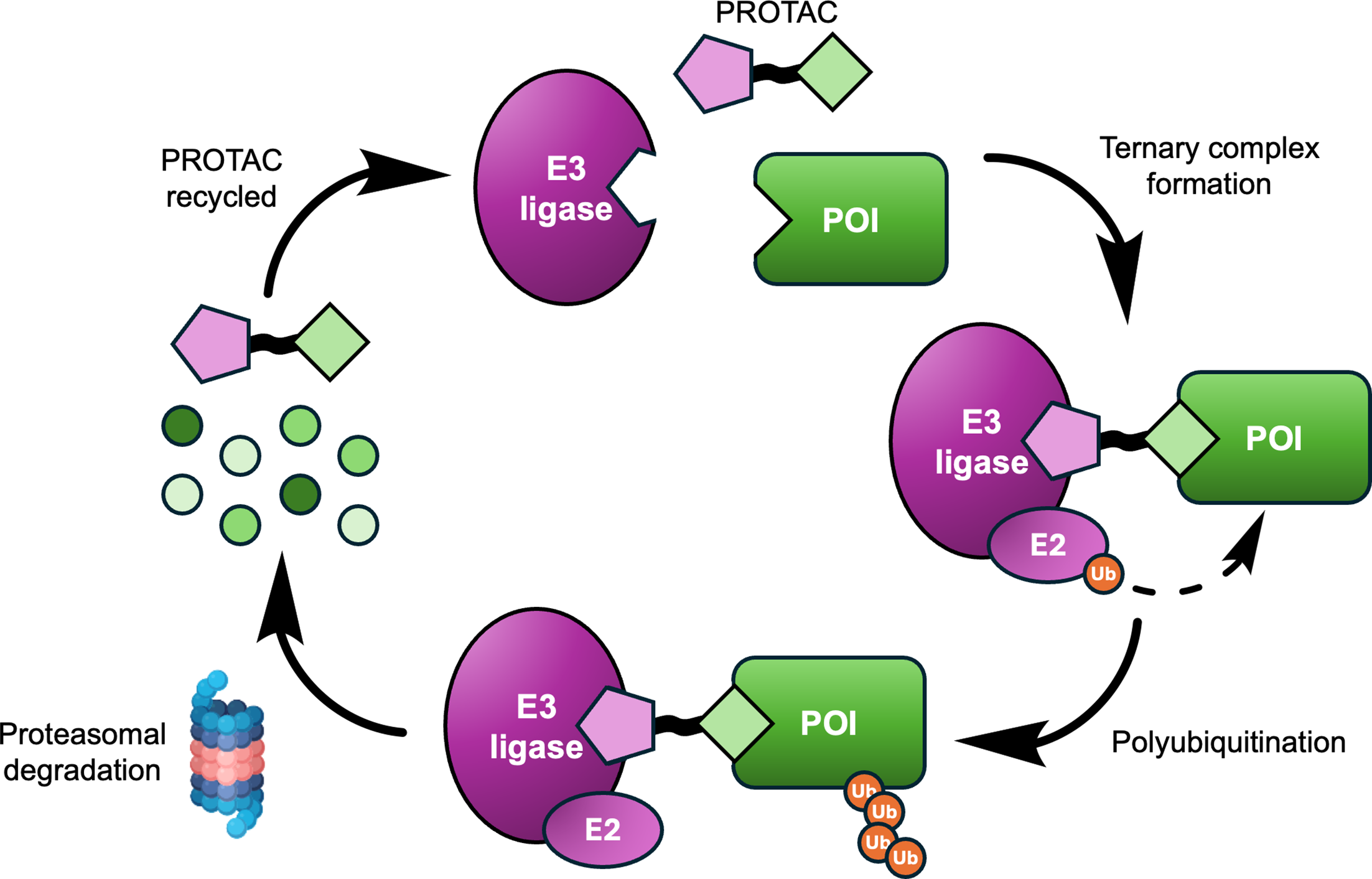
Component logic in context. A PROTAC only works as a system when the warhead, linker, and E3
recruiter together support a productive ternary complex and downstream degradation pathway.
Source: Osman, Thompson, Jörg, and Scanlon, Biochemical Journal (2025),
doi:10.1042/BCJ20243018.
PROTAC component hubs are workflow pages that help users inspect and prepare the three core degrader building
blocks: the POI-binding warhead, the linker, and the E3 recruiter. Each hub focuses on the information needed
before assembly, including binding pose, attachment atoms, linker reach, geometry, scaffold context, and
downstream modeling readiness.
The three core PROTAC components
Warhead / POI ligand
The warhead binds the protein of interest and defines the target-facing anchor. It needs binding-pose context, a plausible solvent-exposed attachment vector, and enough chemical tolerance to support derivatization.
Strong binding alone does not guarantee a useful degrader warhead if the editable atoms are buried or geometry-breaking.
The recruiter binds an E3 ligase and defines the ligase-facing anchor and exit vector. Recruiter choice affects ternary geometry, selectivity, cell context, and off-target risk.
CRBN and VHL are common examples, but recruiter selection should still be structure-aware and context-aware.
Export to Downstream Modeling for geometry checks, ternary modeling, and prioritization.
Use Benchmarking and experiments to validate conclusions instead of relying on assembly alone.
Warhead discovery
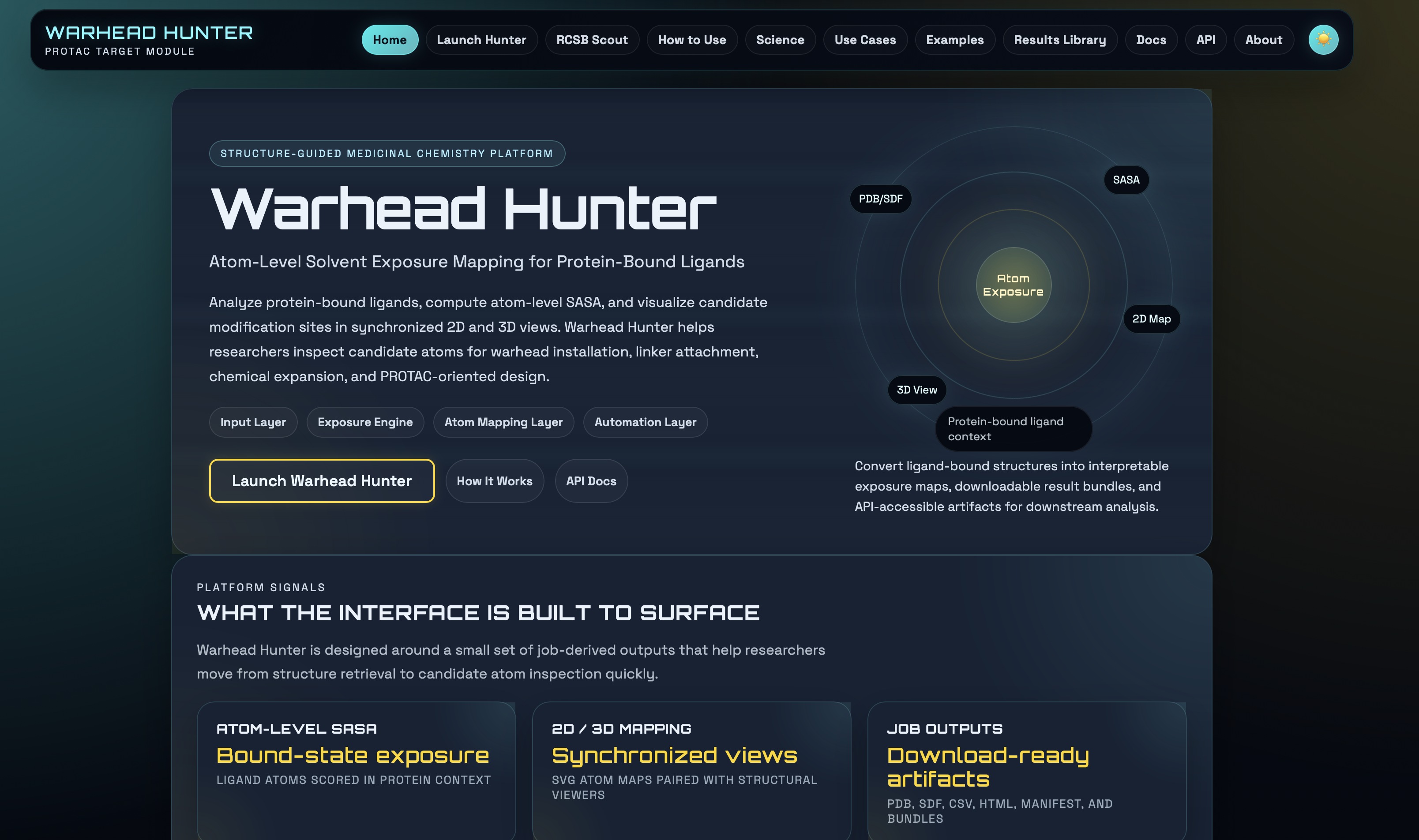
Warhead Hunter is the upstream discovery layer for target-binding ligands. It maps atom-level ligand solvent
exposure in protein-bound structures, helps users search RCSB by PDB ID or by protein and keyword query, and
returns synchronized 2D and 3D views that support attachment-site inspection.
Bound-pose context helps users understand which atoms are buried and which remain solvent-facing.
RCSB Scout supports both known-PDB and protein or keyword search modes.
Exposure mapping is useful design evidence, but not a guarantee of a successful PROTAC warhead.
Warhead Hunter hub. Warhead Hunter converts ligand-bound protein structures into atom-level
solvent exposure maps and downloadable results that can support target-aware warhead planning.
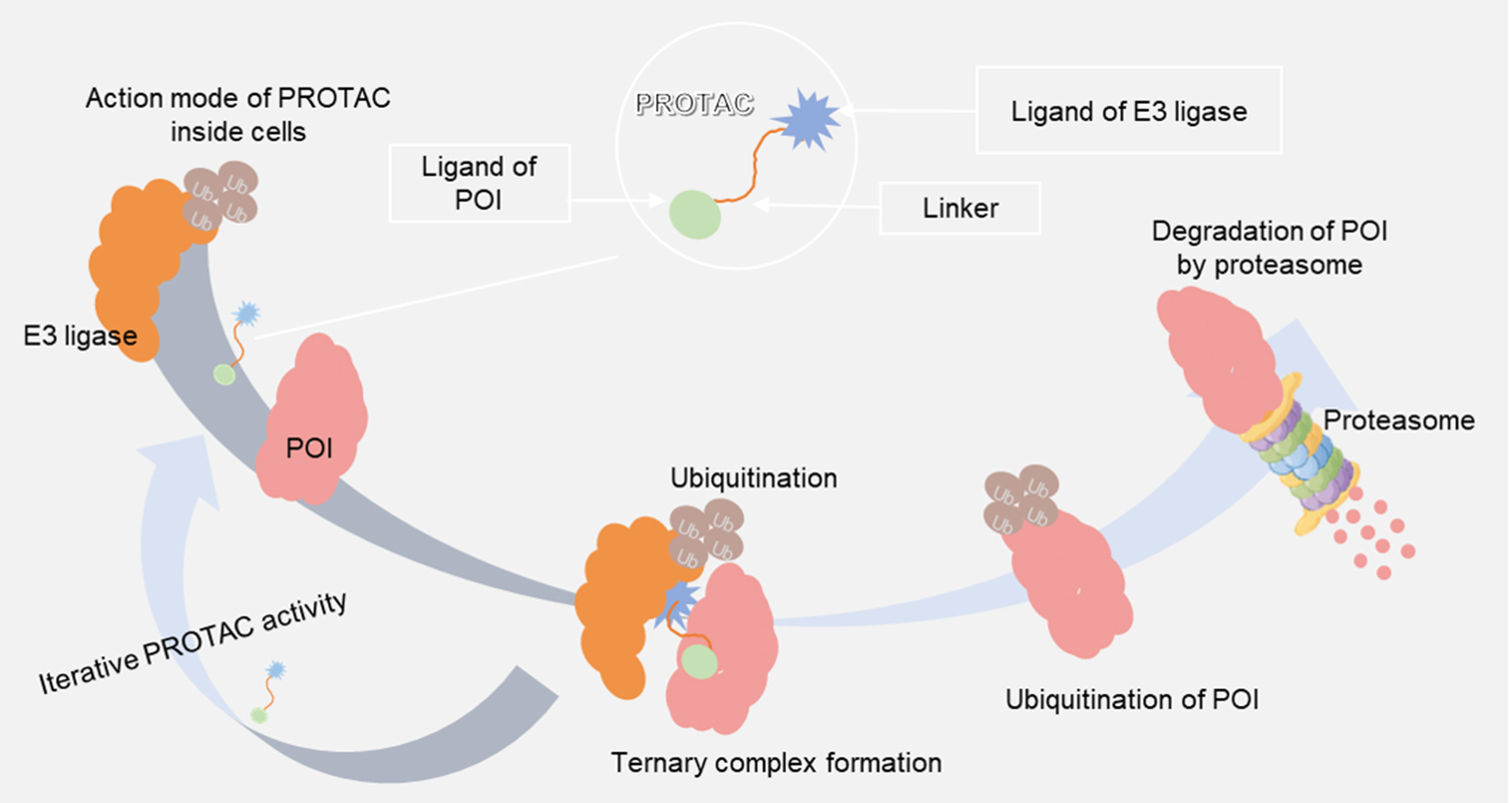
Linker classes. Linker strategy influences reach, conformational freedom, polarity, and much
of the geometric feasibility that connects warheads and recruiters into one degrader hypothesis.
Source: Dong et al., Acta Pharmaceutica Sinica B (2024),
doi:10.1016/j.apsb.2024.04.007.
Linker design is the bridge between component discovery and ternary-complex modeling. Flexible linkers can
sample productive conformations but may pay entropic or permeability costs. Rigid linkers can preserve geometry
but may fail quickly when exit vectors are wrong.
Length should usually be tested systematically instead of guessed once.
Polarity and molecular burden still matter because PROTACs are already large molecules.
Bridgeability should be documented before expensive downstream modeling begins.
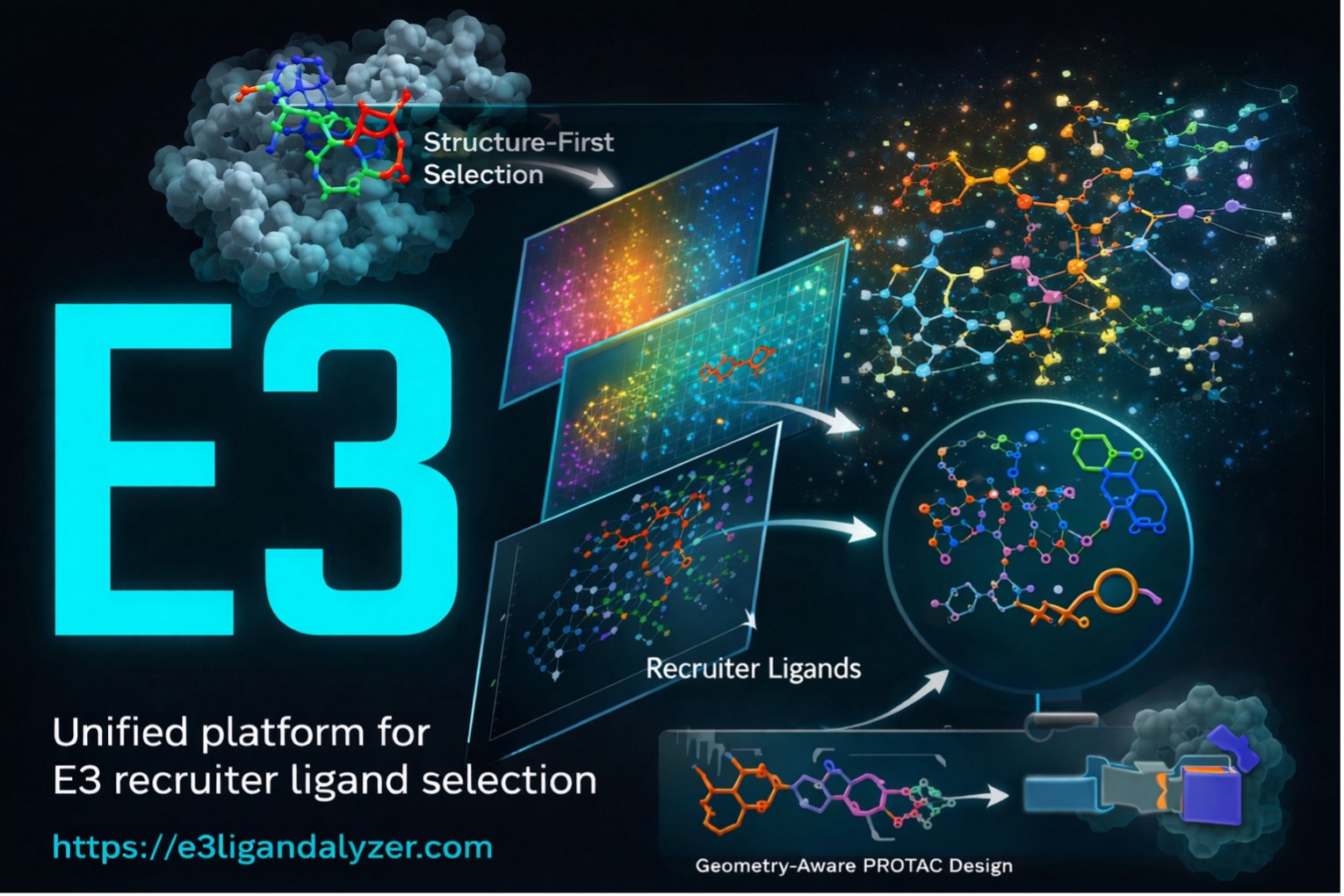
E3 Ligandalyzer is the structure-first discovery layer for ligase-side selection. It helps users compare
recruiter ligands, scaffold diversity, solvent exposure, bound poses, and expression-aware context before
recruiter structures are carried into PROTAC Builder.
Recruiter selection should not be made only by habit or by the popularity of CRBN or VHL.
Bound structures and recruiter-side attachment vectors matter because they shape ternary geometry.
Export workflows support handoff into PROTAC Builder with selected attachment atoms.
V-LiSEMOD supports viral protein-ligand structure exploration and can help users find viral target-bound ligands
and solvent-exposed moieties relevant to warhead discovery. It is especially useful upstream of PROTAC Builder
when the target is viral and users need target-binding structural evidence before assembly.
PROTAC Builder is where selected components become candidate degrader structures. It helps users select or import a
warhead, select or import an E3 recruiter, choose or enumerate linkers, define attachment atoms, assemble
candidates, and export structures for downstream modeling or batch workflows.
What it helps organize
Component boundaries, attachment atoms, assembled candidate structures, linker alternatives, and workflow handoff into modeling or API-based pipelines.
What it does not guarantee
Assembly is a design hypothesis. Productive degradation still requires geometry, downstream modeling where useful, and experimental validation.
Scaffold and expression context have been reviewed.
Assembly
Components have defined boundaries.
Anchor atoms are documented.
Stereochemistry and protonation assumptions are preserved.
Downstream modeling and validation plan exists.
Common component selection mistakes
Warhead-side mistakes
Choosing a warhead only because it binds strongly, selecting a linker attachment atom from 2D alone, or losing attachment-atom context before assembly can undermine the whole degrader hypothesis.
Linker-side mistakes
Treating the linker as a passive spacer, using only one length, or ignoring polarity and bridgeability can make a plausible-looking design impossible in 3D.
Recruiter-side mistakes
Choosing CRBN or VHL only by habit, ignoring E3 expression, and skipping recruiter-side geometry or scaffold review can narrow the design space too early.
Workflow mistakes
Assuming assembled candidates will degrade, skipping downstream modeling, or treating component selection alone as proof of success can create false confidence.
Connected discovery tools
External
Warhead Hunter
Find and inspect target-bound warheads using ligand solvent exposure maps.