About the PROTAC Builder
A next-generation platform for rapid degrader design — bridging chemistry, structural biology, and AI-assisted modeling.
The PROTAC Builder is a free, open-access molecular design platform developed by the University of Miami Schürer System Drug Discovery Lab.
A PROTAC A PROteolysis TArgeting Chimera — a bifunctional degrader that recruits an E3 ligase to destroy a target protein. is a small molecule designed to redirect the cell's ubiquitin–proteasome machinery toward disease-causing proteins. For a deeper introduction and benchmarking analysis, see our 2025 publication in Scientific Reports .
This platform enables rapid web-based construction of complete PROTAC molecules by combining a warhead, chemical linker, and E3 ligase recruiter. Modern degrader design relies heavily on constraint-driven geometric modeling , currently the most accurate computational strategy for evaluating ternary-complex feasibility.
Terms of Use
- ✔ Free for academic, commercial, nonprofit, and personal use.
- ✔ You may export, publish, or commercialize any generated structure.
- ✔ Anonymous logs (timestamp + SMILES only) support community metrics.
- ✔ No cookies, tracking scripts, or personal data collection.
- ✔ Results are provided as-is and should be scientifically verified.
How the Builder Works
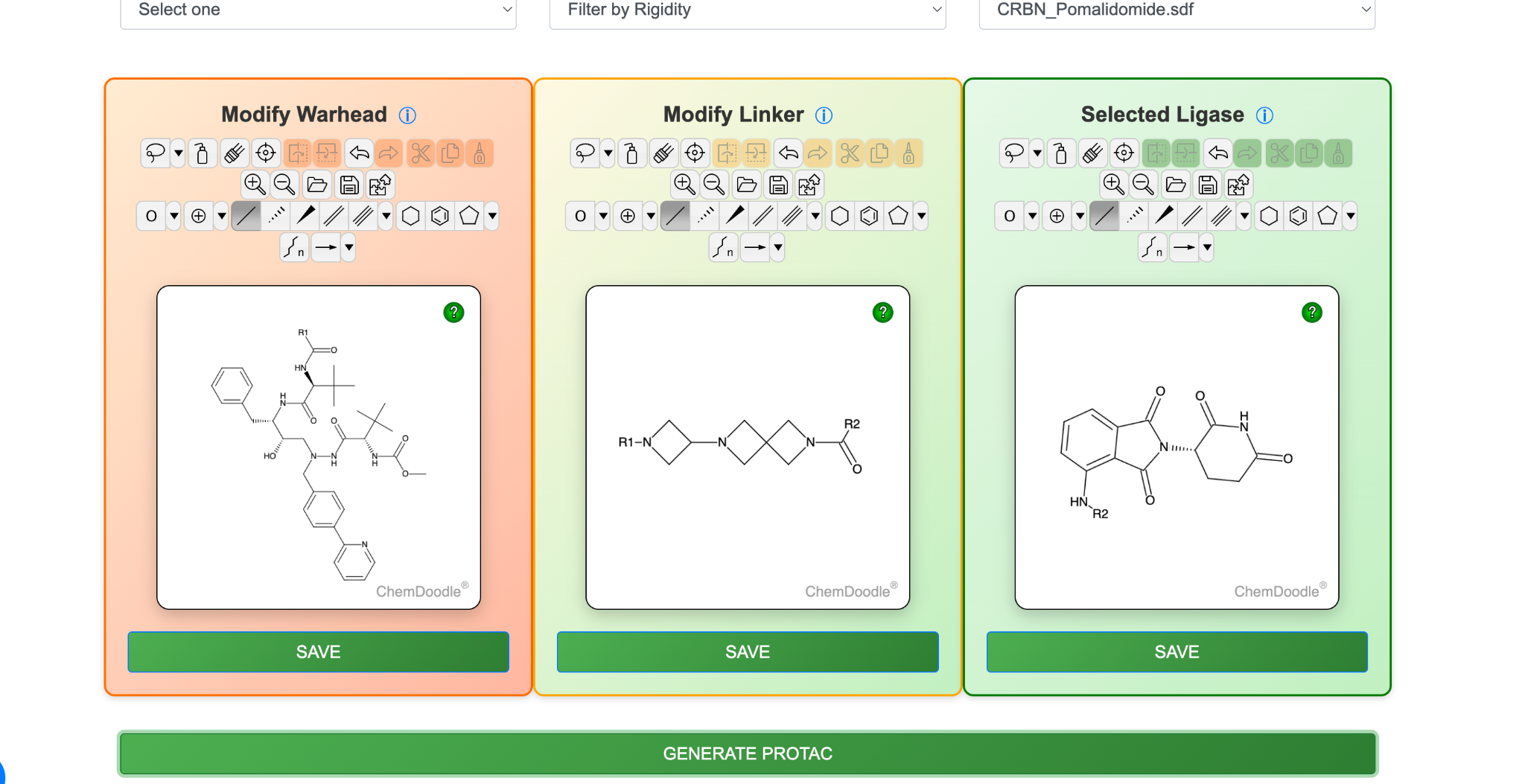
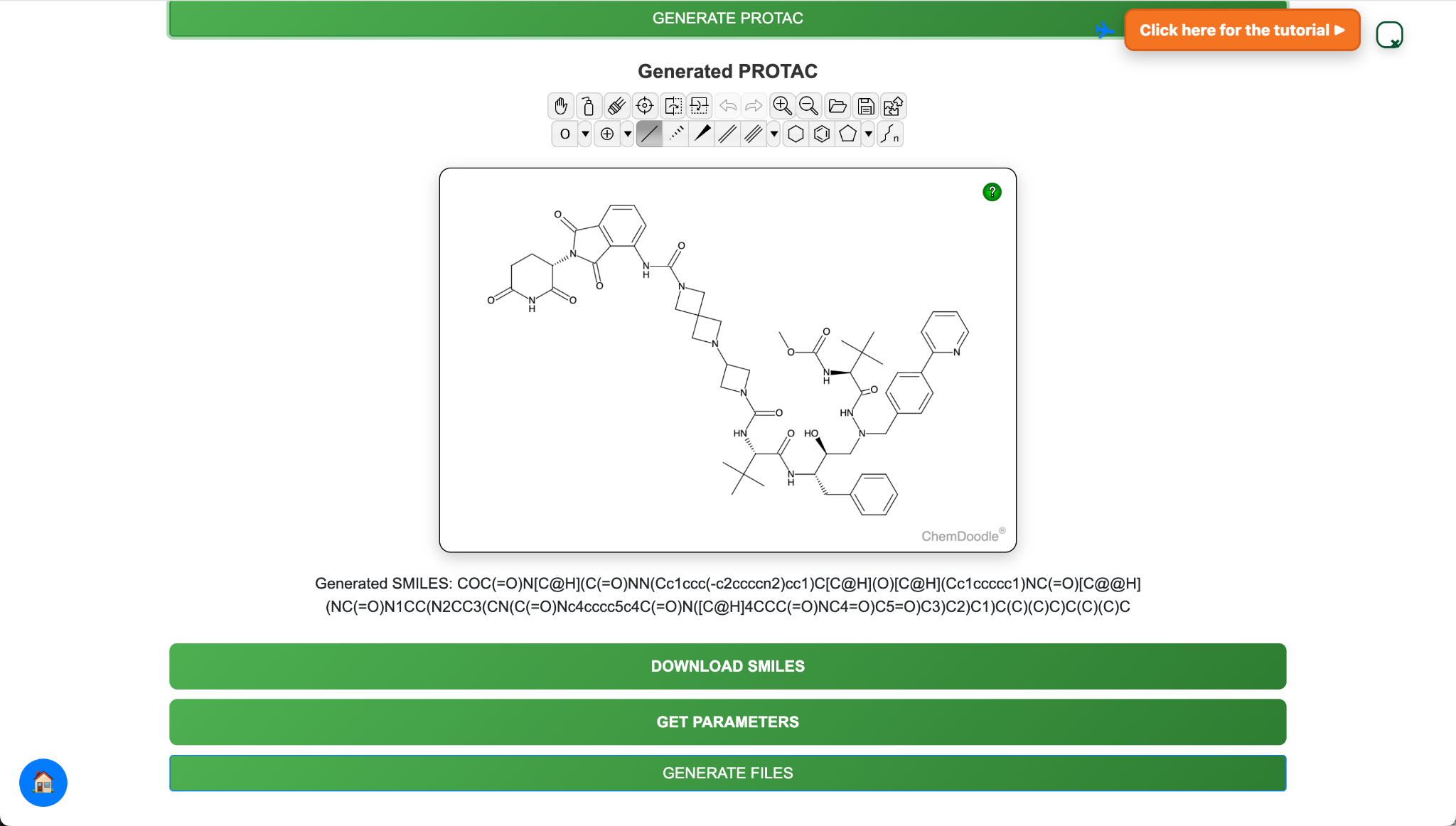
The PROTAC Builder uses three synchronized ChemDoodle editors—Warhead, Linker, and E3 Ligase Recruiter—to create complete bifunctional degrader molecules. Once assembled, the builder merges fragments, generates a clean 3D-ready MOL, and outputs canonical SMILES suitable for PRosettaC, docking workflows, MD simulations, and cheminformatics pipelines.
Scientific Context
Accurate structural modeling of PROTAC ternary complexes remains one of the most persistent challenges in degrader design. Even small geometric distortions between the warhead, linker, and E3-recruiting ligand can dramatically alter whether a ternary complex is physically achievable.
Our 2025 study,
“PRosettaC outperforms AlphaFold3 for modeling PROTAC ternary complexes”
(Scientific Reports), provides the first systematic benchmarking of
constraint-driven geometric modeling
(PRosettaC) versus
deep-learning whole-complex prediction
(AlphaFold3).
We analyzed 36 experimentally solved PROTAC ternary complexes and found that
geometry-constrained sampling consistently produced ternary poses with higher
DockQ
DockQ v2 — a 0–1 interface-quality score that measures how well
two biomolecules interact (higher = better agreement with the reference structure).
• 0.80–1.00 → Near-Native Interface
• 0.50–0.80 → Medium Interface
• 0.23–0.49 → Acceptable Interface
• 0.00–0.23 → Incorrect Interface
DockQ v2 supports protein–protein, protein–nucleic acid, and
protein–small-molecule interactions — making it ideal for evaluating
PROTAC ternary complexes. It allows direct comparison of different
linker designs on the same target–E3 interface to identify which
linker geometries produce the most native-like interactions.
agreement, especially when linker conformational space was well-anchored
by known attachment atoms.
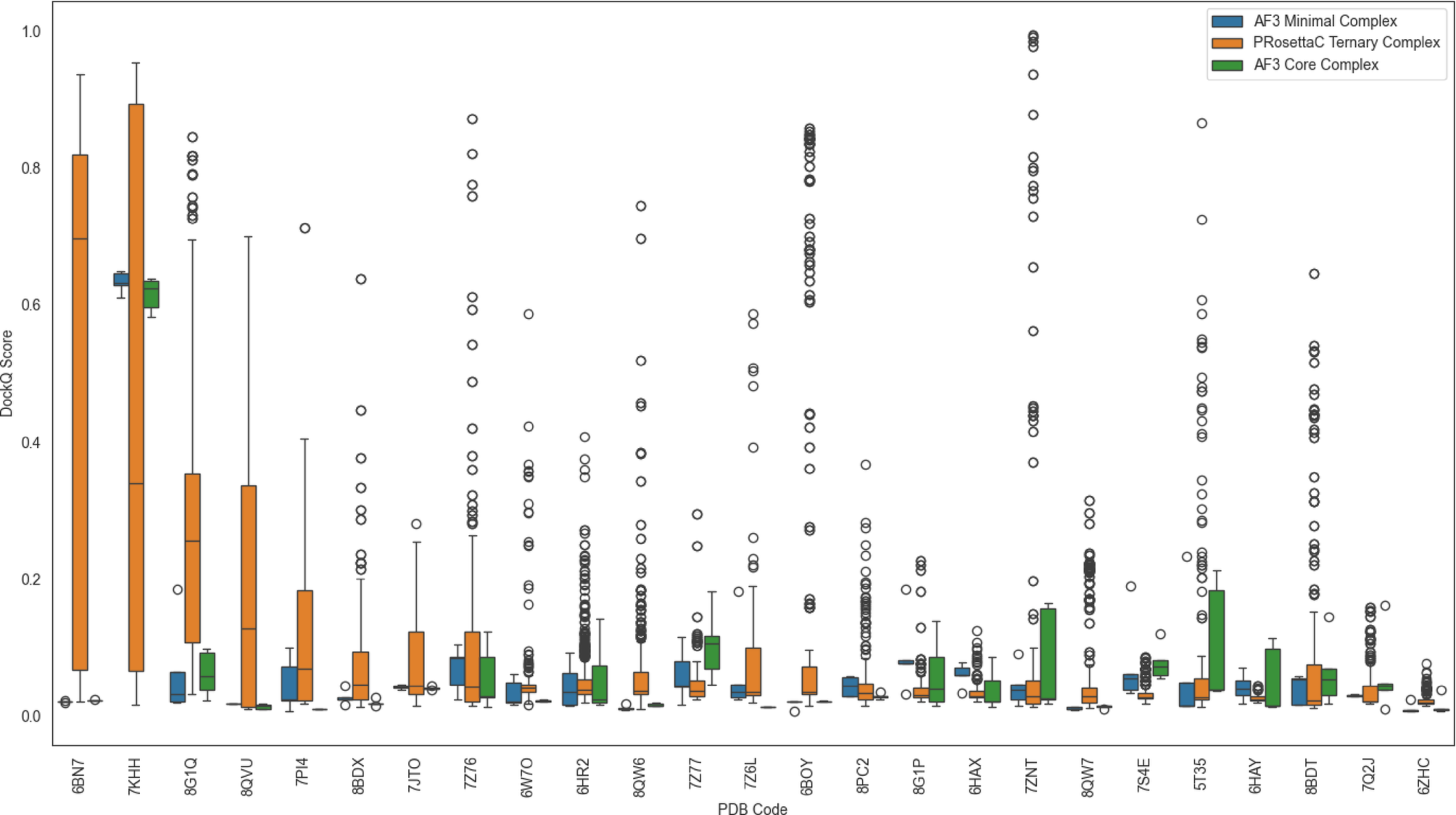
AlphaFold3 accurately models local interfaces, but without explicit geometric constraints, it tends to hallucinate linker trajectories or collapse the degrader into non-physical poses — a limitation particularly evident for flexible or long linker chemotypes.
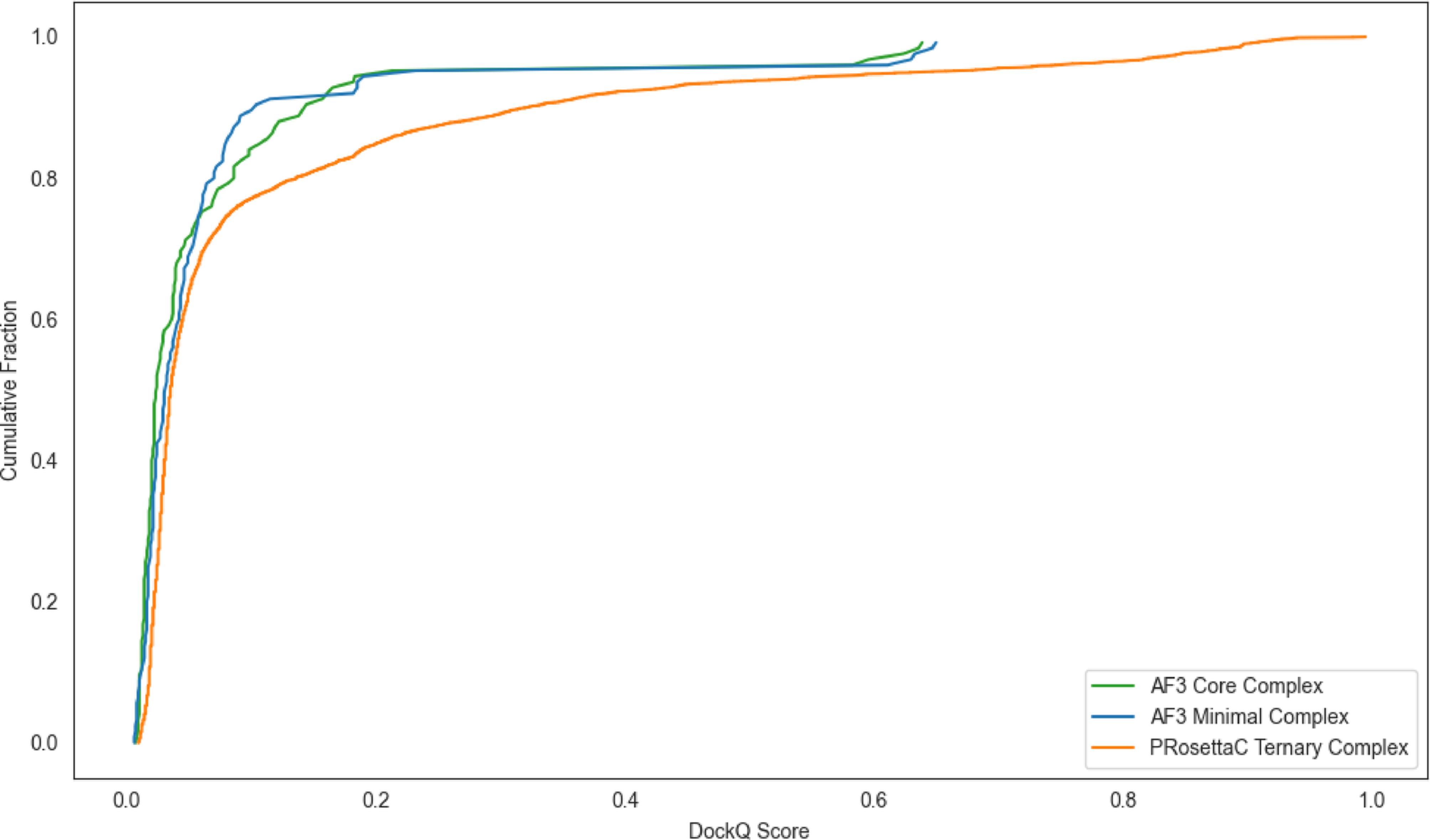
The PROTAC Builder bridges this gap by generating chemically accurate SMILES + anchor-aligned linker geometries, fully compatible with PRosettaC, allowing researchers to explore biophysically plausible ternary assemblies with far greater control.
Tool Integrations
The PROTAC Builder is part of a unified molecular-design ecosystem developed by the University of Miami Schürer Lab. Together, these tools accelerate degrader discovery by integrating structural biology, ligand intelligence, and cheminformatics.
V-LiSEMOD
Viral-Ligand Solvent Exposed Moiety Database
V-LiSEMOD provides curated viral protein–ligand structures annotated with solvent-exposed moieties and fragmentable chemotypes. Warheads identified here drop seamlessly into the PROTAC Builder.
Explore V-LiSEMOD →Ligandalyzer
E3 Recruiter Explorer
Ligandalyzer maps and clusters all published E3 ligase recruiters, including scaffolds, attachment vectors, and tissue profiles. Any recruiter can be exported directly into the PROTAC Builder.
Open Ligandalyzer →Warhead Hunter
Target Ligand Explorer
Warhead Hunter helps identify and organize target-binding ligands, warhead opportunities, and fragmentable chemotypes for degrader design. Candidate warheads discovered here can feed directly into the PROTAC Builder workflow.
Open Warhead Hunter →Unified Workflow
End-to-End Degrader Discovery Ecosystem
The Schürer Lab platform is not a collection of isolated tools — it is a connected molecular-design ecosystem built to support every major stage of modern degrader discovery. V-LiSEMOD enables discovery of structurally annotated ligand starting points and solvent-exposed warhead opportunities; Warhead Hunter expands target-ligand and warhead exploration; Ligandalyzer maps E3 ligase recruiters, scaffolds, and attachment strategies; PROTAC Builder rapidly assembles complete degrader designs; and PyMACS supports downstream molecular analysis and computational workflows.
Together, these tools create a vertically integrated pipeline that moves from ligand discovery to warhead selection, recruiter optimization, PROTAC assembly, and finally into modeling, docking, and simulation-ready outputs. The result is a faster, smarter, and more scientifically grounded path from idea to degrader candidate.
- 📌 Discover high-value ligands, warheads, and fragmentable chemotypes
- 📌 Compare E3 recruiters, attachment vectors, and scaffold families
- 📌 Build complete PROTAC designs in seconds through the PROTAC Builder
- 📌 Export candidates into PRosettaC, docking pipelines, MD workflows, and analytical toolchains
- 📌 Keep the full design process inside one unified Schürer Lab ecosystem
Explore More Tools
Contact
For collaborations or bug reports:
Developed by Joseph-Michael Schulz
University of Miami — Schürer Lab