The same ligand can be useful or unusable depending on how it binds. A strong binder in abstract 2D chemistry may still be a poor PROTAC warhead if the only editable atoms are buried in the protein interface.
Warhead Discovery
PROTAC Warhead Discovery
A PROTAC warhead is the target-binding component that anchors the degrader to the protein of interest. Before a linker is attached, users need to understand the warhead’s bound pose, which atoms remain solvent-exposed, and whether the proposed attachment vector points into open space rather than disrupting key binding interactions.
This page connects PROTAC Builder to the live Warhead Hunter ecosystem. The goal is not just to find a binder, but to inspect whether that binder has a usable modification site for PROTAC-oriented chemical expansion and downstream ternary-complex design.
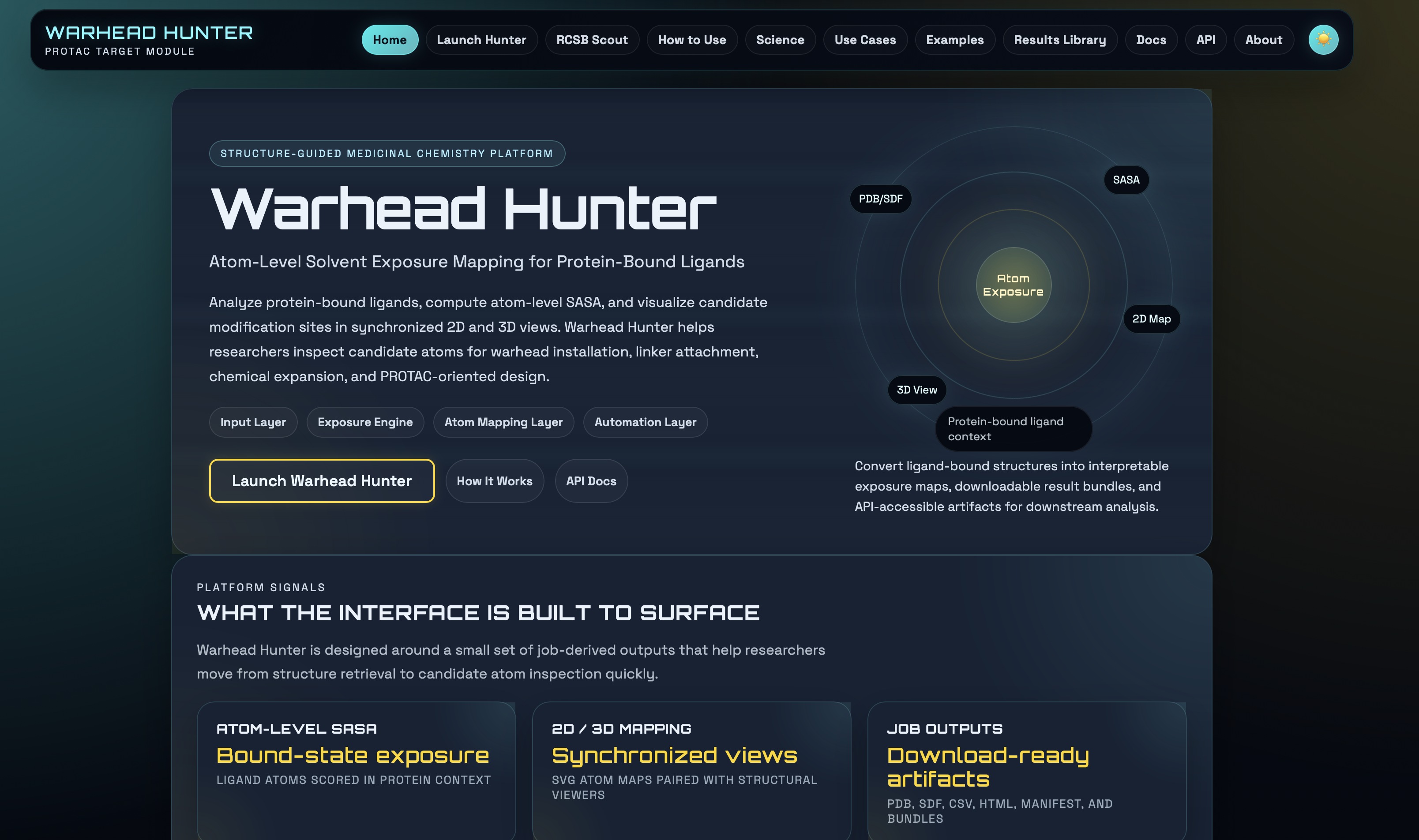
Protein-bound ligand context
Atom-level SASA
2D / 3D inspection
PROTAC attachment planning
Quick answer: what is a PROTAC warhead?
A PROTAC warhead is the target-binding ligand or chemical motif that recognizes the protein of interest. In degrader design, the warhead must bind the target and provide a plausible attachment atom or exit vector for a linker without destroying the interactions that make the warhead bind.
Practical takeaway: warhead discovery is not only about finding a binder. It is about finding a
binder with a usable modification site.
Why warhead context matters
Atoms buried in the binding site are often important for recognition. Solvent-exposed atoms can be better starting points for chemical expansion or linker attachment.
Warhead attachment choice influences exit vector, steric burden, linker bridgeability, ternary-complex geometry, and downstream degradation potential.
Strong target binding alone does not guarantee a useful PROTAC warhead. The molecule still needs a modification site that can support the rest of the degrader architecture.
Warning: do not choose an attachment atom from the 2D structure alone. Inspect the ligand in the
protein-bound 3D context whenever possible.
Ligand solvent exposure mapping
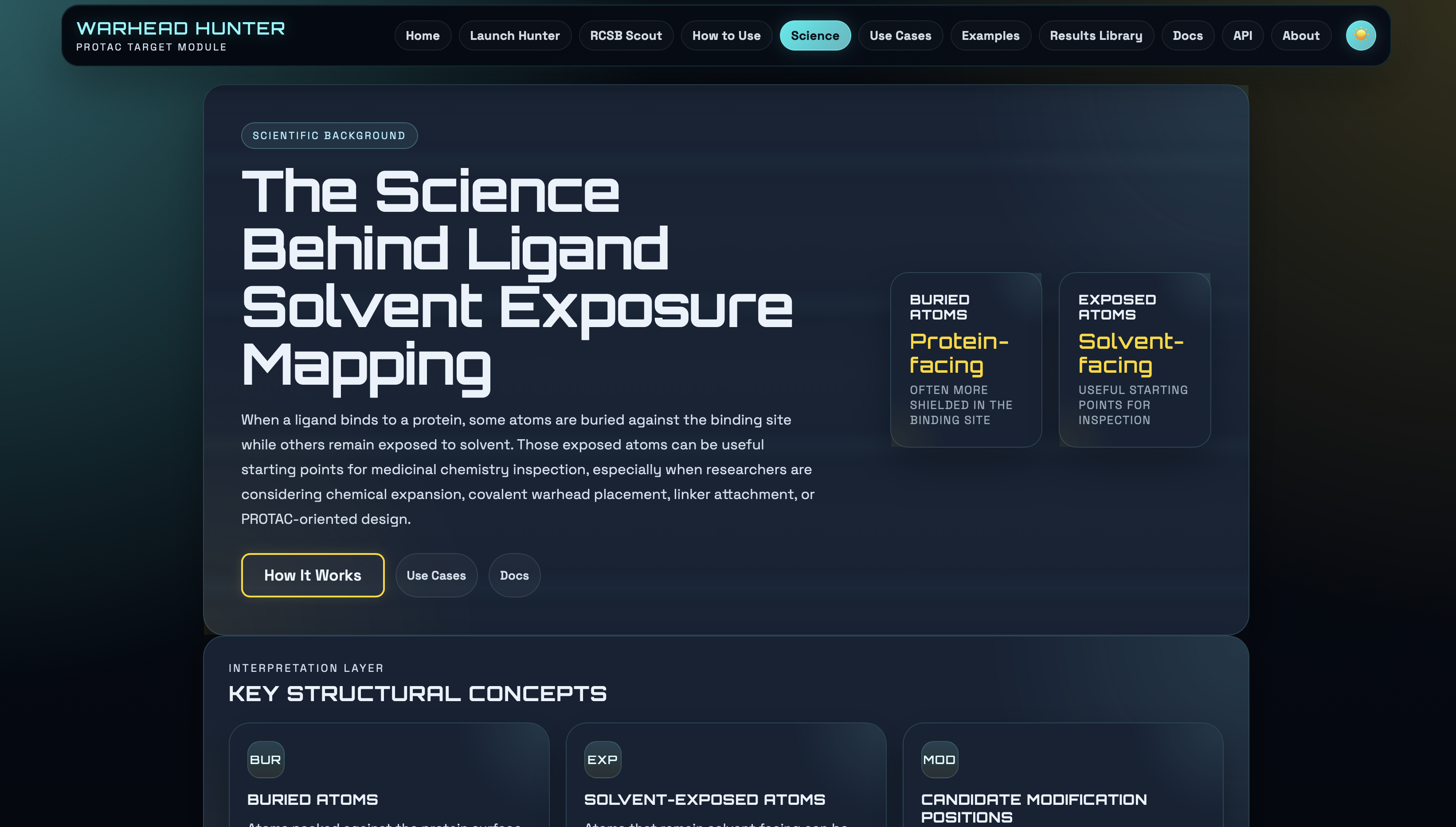
Warhead Hunter is built around a simple but useful scientific idea. When a ligand binds a protein, some atoms are buried against the binding site while others remain exposed to solvent. Those solvent-facing atoms can be candidate modification positions for warhead elaboration, linker attachment, or PROTAC-oriented design review.
- Buried atoms are often more protein-facing and should usually be modified cautiously.
- Solvent-exposed atoms can be useful starting points for modification-site inspection.
- Atom-level solvent-accessible surface area can help prioritize atoms for closer review.
- Exposure mapping is a guide, not a guarantee of successful chemistry or degradation.
Search RCSB for ligand-bound protein structures
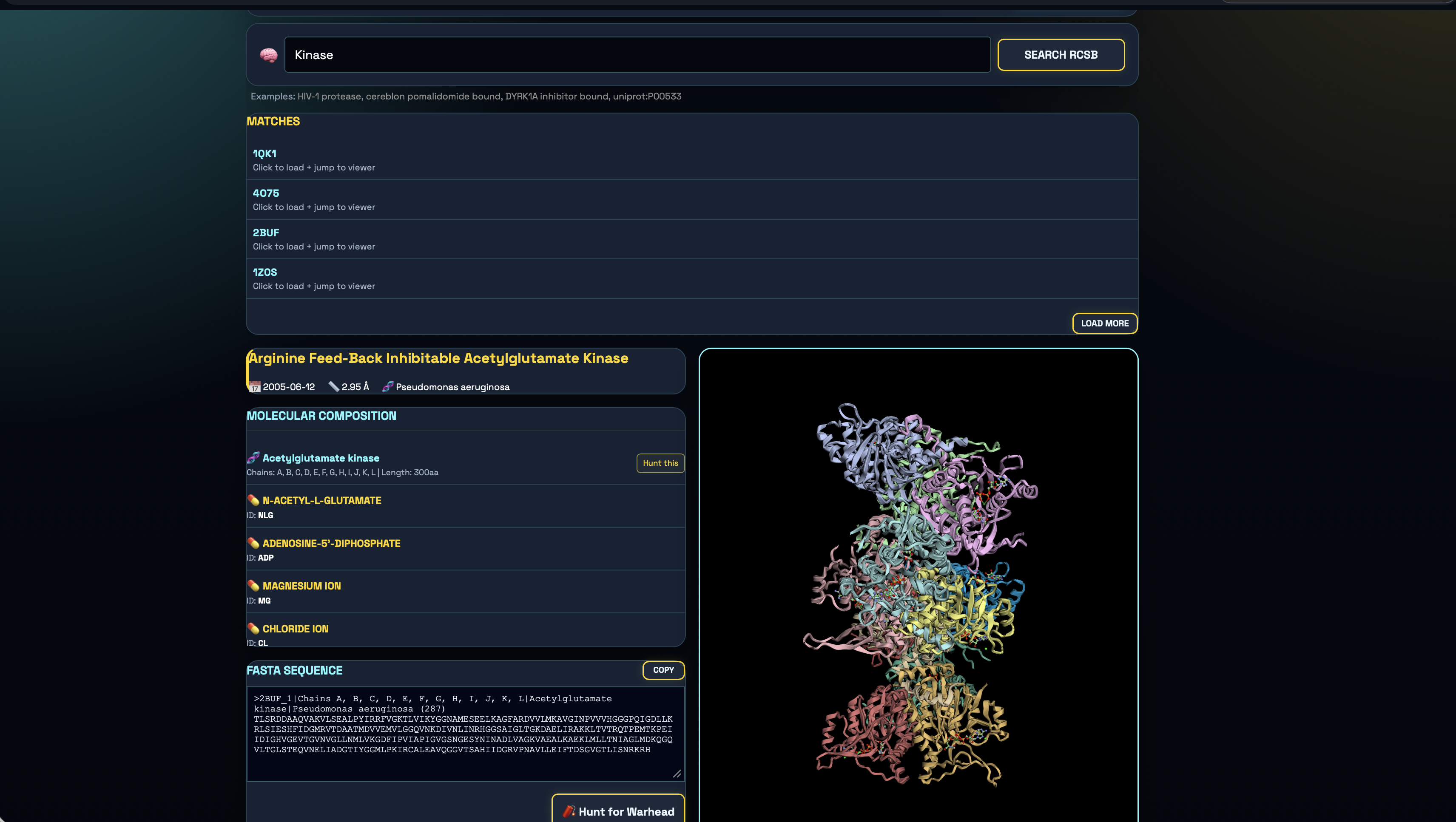
RCSB Scout helps users query ligand-bound protein structures before launching a warhead hunt. It supports two practical modes: search by known PDB ID when you already know the structure, or search by protein or keyword when you need discovery help across the broader RCSB archive.
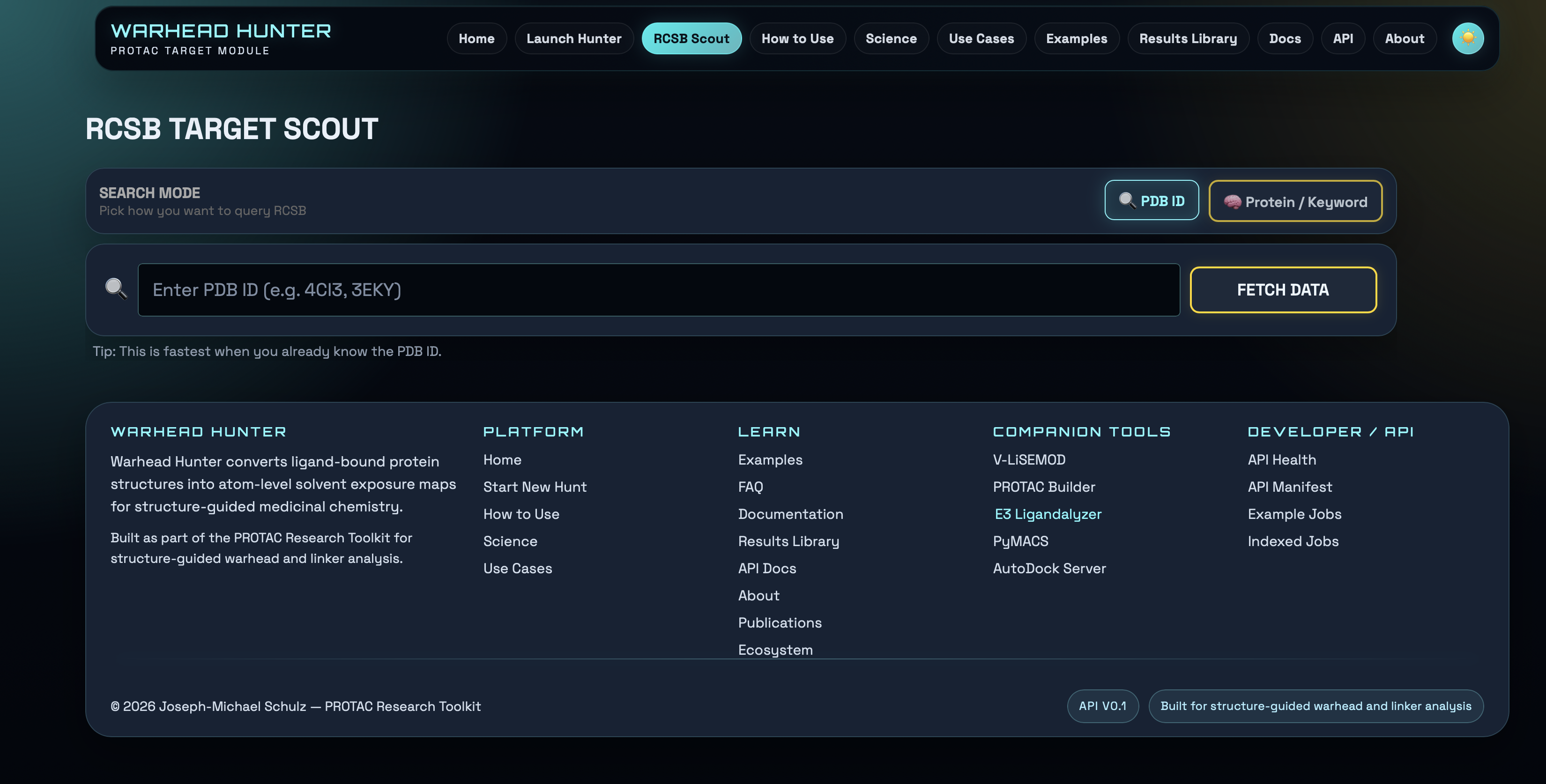
- Use PDB ID mode when you already know the structure you want.
- Use protein or keyword mode for terms like “DYRK1A inhibitor bound” or “cereblon pomalidomide bound.”
- Search results can reveal structures worth sending into Warhead Hunter for solvent-exposure analysis.
Use Warhead Hunter for PROTAC design
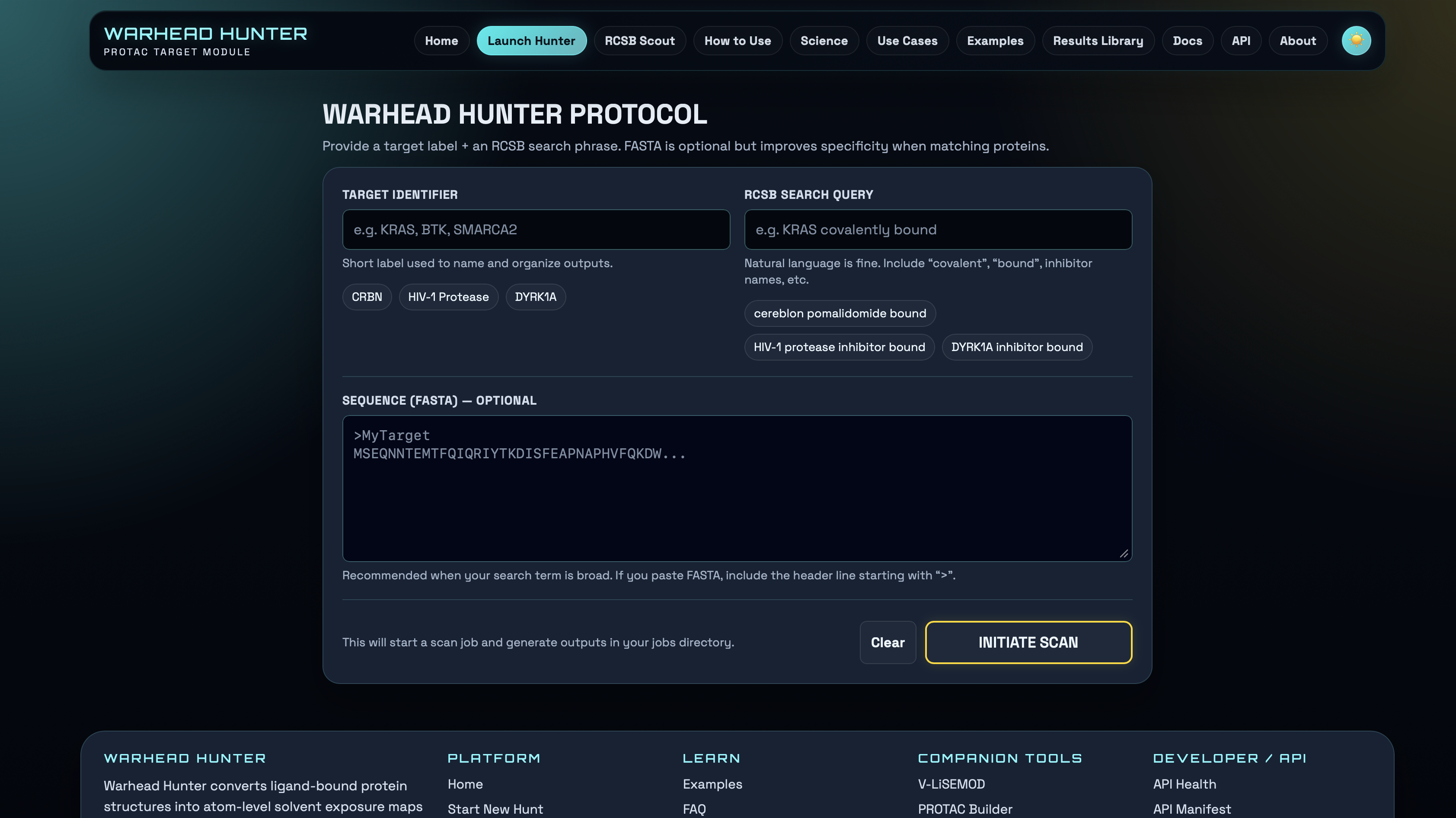
The launch workflow is meant to be practical rather than magical. Users provide enough context for Warhead Hunter to retrieve candidate ligand-bound structures and organize outputs into interpretable result views and downloadable artifacts.
- Provide a target label for bookkeeping and result organization.
- Provide an RCSB search query, which can be a PDB ID, protein name, or natural-language query.
- Optionally provide FASTA when the target name is broad or specificity matters.
- Submit a scan job and inspect the returned structures and exposure maps.
Example search ideas
`CRBN`, `HIV-1 protease inhibitor bound`, `DYRK1A inhibitor bound`, and `cereblon pomalidomide bound` are all useful styles of starting query, but results still need inspection.
Caution
Not every query will return a perfect structure, and not every ligand-bound structure will support a useful PROTAC warhead hypothesis.
Inspect results: 3D context and 2D ligand maps
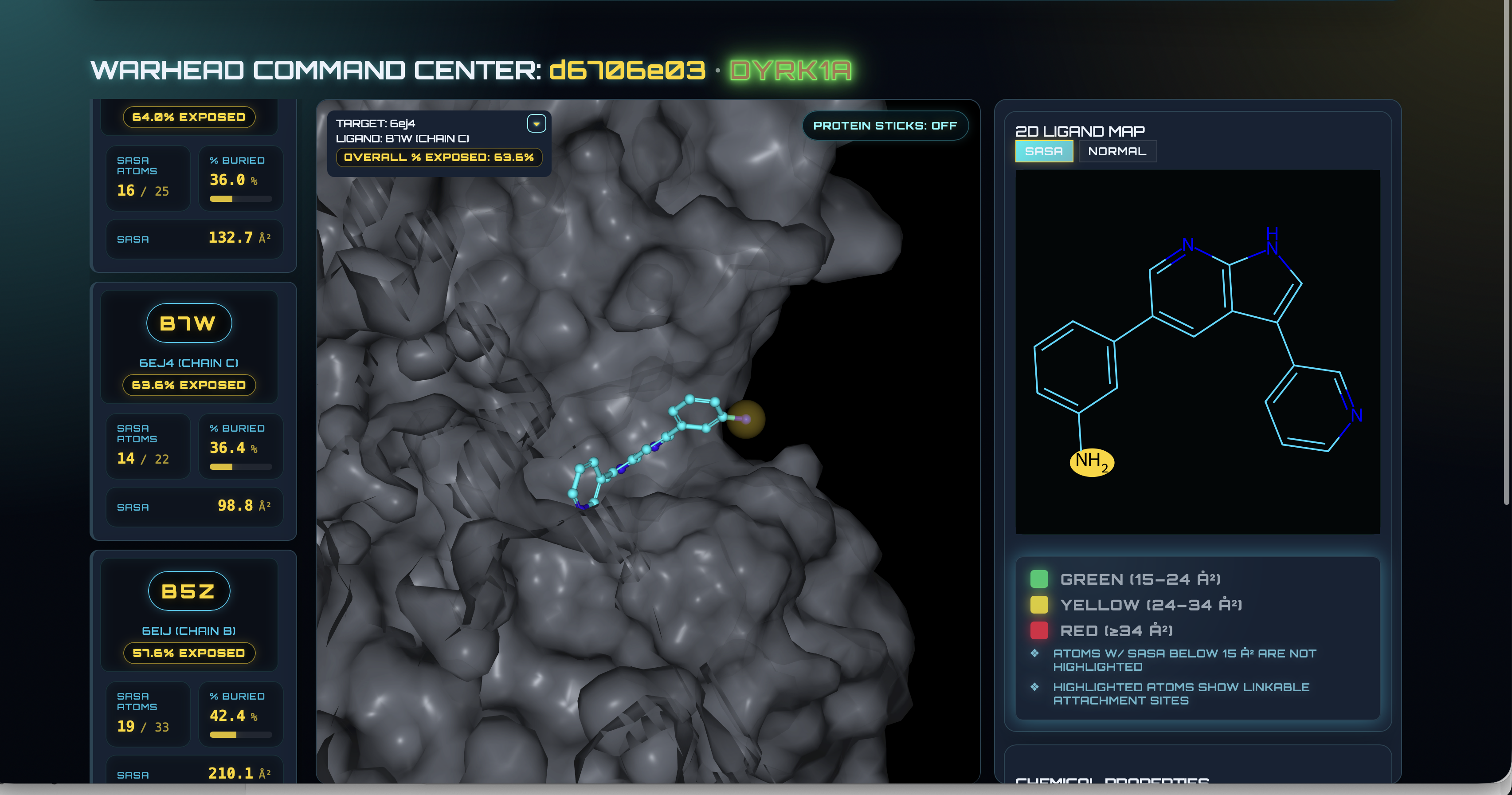
Warhead Hunter results are useful because they keep the protein-bound context visible. Users can inspect whether candidate atoms are exposed or buried, review synchronized 2D ligand maps, and compare candidate modification sites before deciding what should come back into PROTAC Builder.
- 3D views help inspect whether a candidate atom points toward solvent or protein volume.
- 2D ligand maps highlight SASA or exposure categories for quick comparison.
- Results can inform linker attachment planning, not just warhead selection.
Learn from public example pages
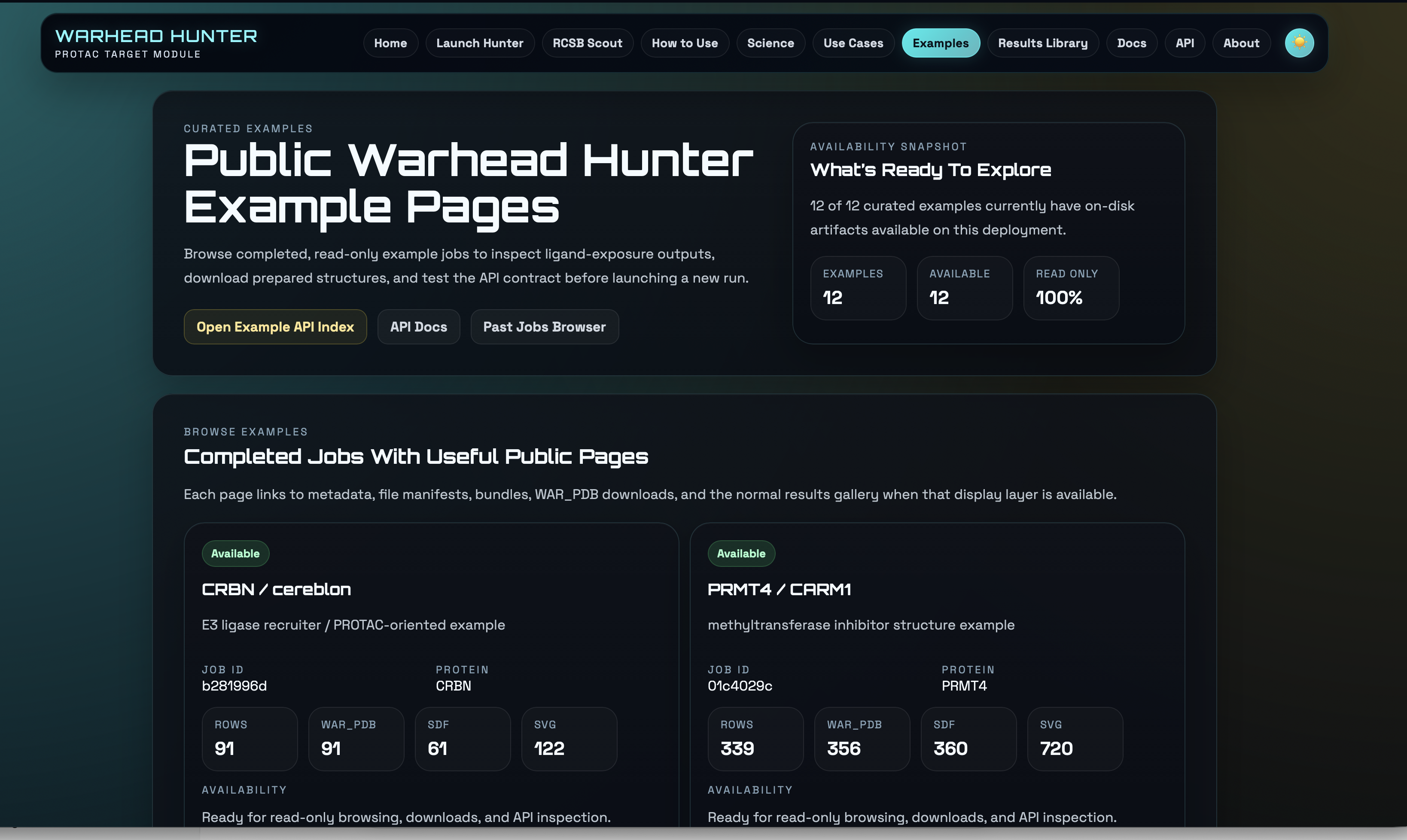
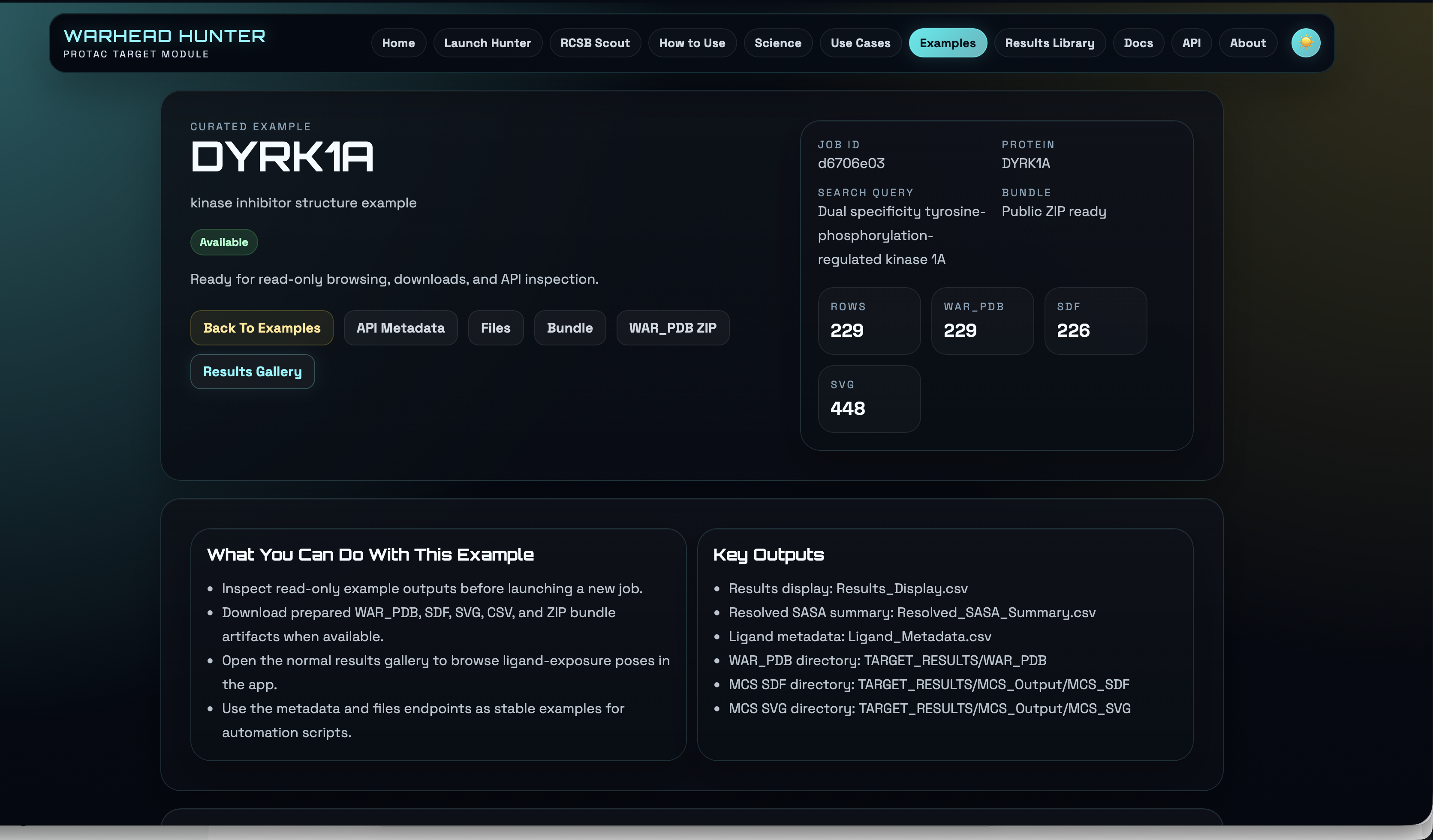
Public example pages are a low-friction way to understand the workflow before launching your own job. They show what completed, read-only jobs look like, including file manifests, downloadable bundles, and links into richer result galleries.
Automate warhead discovery with the API
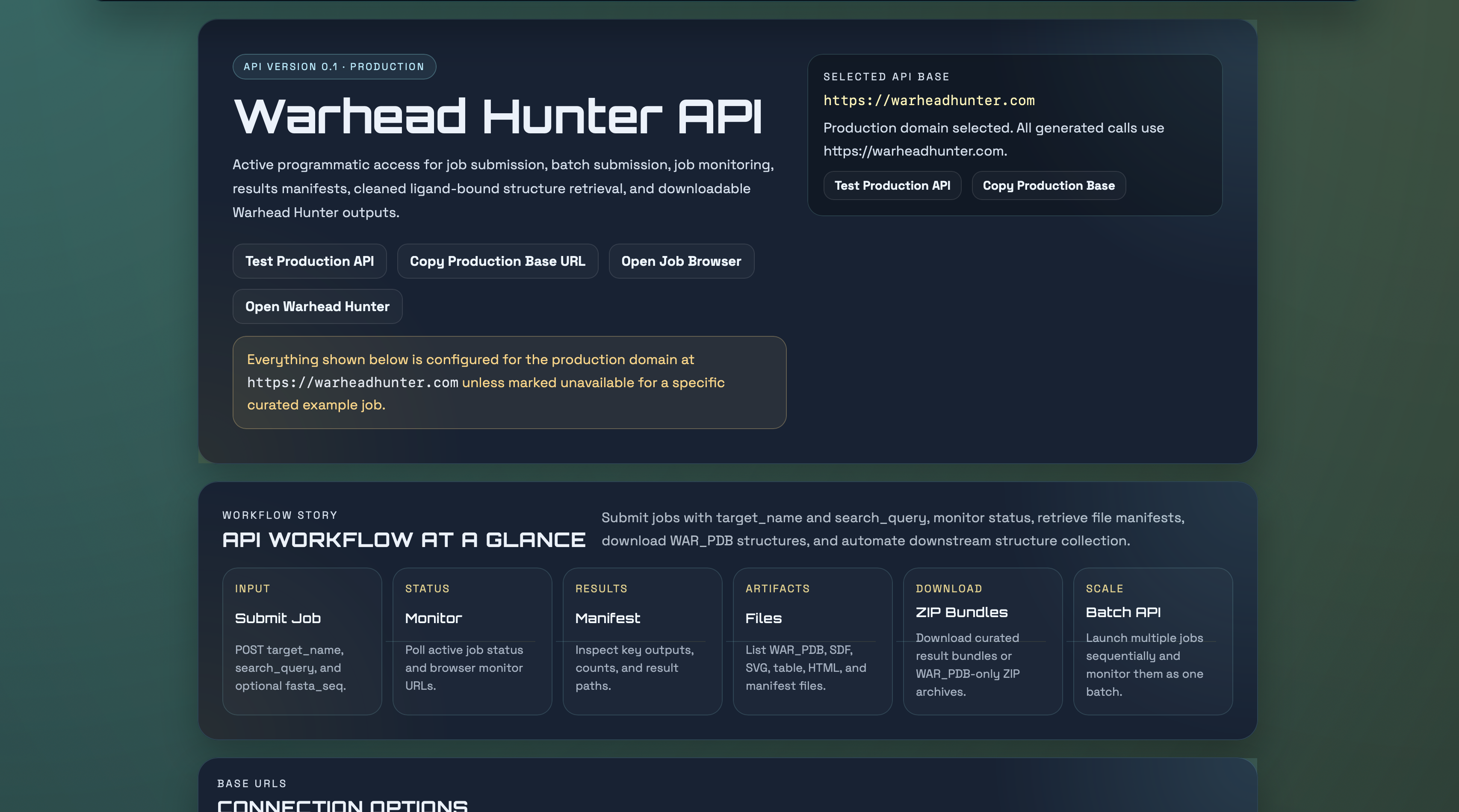
Warhead Hunter also supports programmatic workflows. The API layer is useful when users want reproducible job submission, job monitoring, result manifests, file retrieval, and larger batch-oriented discovery campaigns.
- Submit jobs programmatically.
- Monitor job status and manifests.
- Download WAR_PDB structures, SDF outputs, SVG atom maps, and other artifacts.
- Connect result retrieval to downstream analysis or batch pipelines.
Bring warheads into PROTAC Builder
What should come back from Warhead Hunter
- Target name and protein context.
- PDB ID or other structure source.
- Ligand identity and bound-pose context.
- Candidate solvent-exposed attachment atoms.
- Notes about buried atoms or atoms to avoid.
- SDF, MOL, or SMILES where available.
- Selected warhead structure and target-facing attachment atom.
- Any uncertainty or alternate attachment vectors worth testing.
How PROTAC Builder uses that handoff
- Import or select the warhead.
- Define the target-facing attachment atom.
- Pair the warhead with an E3 recruiter.
- Select or enumerate linkers.
- Export assembled candidates for downstream modeling and experimental follow-up.
Scope reminder: PROTAC Builder helps organize component and attachment-site hypotheses. It does
not guarantee productive degradation.
Practical warhead selection checklist
Does the warhead bind the intended protein of interest?
Is there a ligand-bound structure or credible modeled pose?
Is the binding mode relevant to the biological target context?
Are key binding interactions preserved?
Is at least one plausible atom solvent-exposed?
Does the candidate attachment atom point toward solvent or open interface space?
Could modification disrupt binding or selectivity?
Is the warhead compatible with a linker attachment strategy?
Are alternate attachment atoms worth testing?
Can the warhead be exported or redrawn for PROTAC Builder?
Is experimental validation planned?
Common warhead discovery mistakes
Choosing a ligand only because it binds strongly
Strong affinity is useful, but it does not tell you whether the ligand has a usable modification site for degrader design.
Ignoring the protein-bound pose
A warhead should be inspected in bound 3D context whenever possible, not just as a flat 2D drawing.
Selecting a buried atom as the linker attachment site
Buried atoms are more likely to participate in key binding interactions or point into protein volume.
Assuming solvent exposure guarantees success
Exposure is useful, but it does not guarantee clean chemistry, preserved binding, or productive ternary geometry.
Treating RCSB hits as final answers
RCSB search results are a starting point. Structure quality, construct relevance, ligand identity, and binding context still need review.
Forgetting the rest of the degrader
Even a good warhead must still work with a recruiter, linker, ternary-complex geometry, and downstream validation plan.
Recommended workflow
- Start with a protein of interest or disease-relevant target.
- Search known ligand-bound structures using RCSB Scout.
- Launch a Warhead Hunter job with target label, query, and optional FASTA.
- Inspect 3D ligand-binding context.
- Review 2D atom exposure maps.
- Select candidate modification atoms.
- Download or record warhead artifacts.
- Bring the warhead into PROTAC Builder.
- Pair it with an E3 recruiter and linker panel.
- Use downstream modeling and experimental validation.
Connected tool ecosystem
Warhead Hunter
Live warhead-focused discovery for ligand-bound structure retrieval, exposure mapping, and candidate attachment-site inspection.
Open Warhead Hunter ↗Warhead Hunter Science
Read the scientific background for atom-level solvent exposure mapping and modification-site interpretation.
Open science page ↗RCSB Scout
Search ligand-bound structures by PDB ID or by protein and keyword query before launching a warhead hunt.
Open RCSB Scout ↗Warhead Hunter Examples
Review completed public jobs before launching your own scans.
Open examples ↗Warhead Hunter API Docs
Use the API layer for job submission, monitoring, manifests, downloads, and automation.
Open API docs ↗PROTAC Builder
Bring inspected warhead candidates back into the builder for recruiter pairing and linker assembly.
Return to builderLinker Design
Review bridgeability, flexibility, polarity, and exit-vector implications before final assembly.
Open linker guideE3 Recruiter Discovery
Connect warhead-side decisions with recruiter pose, solvent exposure, and E3 context.
Explore E3 recruitersDownstream Modeling
Follow builder outputs into ternary-complex modeling, scoring, and refinement workflows.
Open downstream modelingFrequently asked questions
What is a PROTAC warhead?
A PROTAC warhead is the target-binding ligand or chemical motif that anchors the degrader to the protein of interest.
How do I choose a warhead for a PROTAC?
Choose a warhead by looking at target binding, bound-pose context, solvent exposure, attachment-site plausibility, and whether the warhead can support the rest of the degrader geometry.
Why does solvent exposure matter for warhead design?
Because solvent-facing atoms can be more useful starting points for modification-site inspection, while buried atoms are more likely to be important for binding.
What is a linker attachment site?
It is the atom or functional position chosen for expansion so the warhead can be connected to a linker and, later, to an E3 recruiter.
Can I choose an attachment atom from a 2D structure alone?
Usually not. You should inspect the atom in the protein-bound 3D context whenever possible.
What is Warhead Hunter?
Warhead Hunter is a structure-guided platform that converts ligand-bound protein structures into atom-level exposure maps and synchronized 2D/3D inspection views.
What does RCSB Scout do?
RCSB Scout helps users search RCSB by known PDB IDs or by protein and keyword queries before launching Warhead Hunter jobs.
What files does Warhead Hunter produce?
It can produce prepared structure files, ligand SDF outputs, exposure tables, SVG maps, manifests, and downloadable job bundles.
How do Warhead Hunter results connect to PROTAC Builder?
They help users identify candidate attachment atoms and carry target, ligand, and pose context back into PROTAC Builder for assembly.
Does Warhead Hunter guarantee a successful PROTAC?
No. It supports inspection and prioritization, but it does not guarantee successful warheads, ternary complexes, or degradation.
What should I do after selecting a warhead?
Bring the warhead into PROTAC Builder, define the attachment atom, pair it with recruiters and linkers, and then use downstream modeling and experiments for validation.