E3 recruiter selection is one of the earliest and most important decisions in PROTAC design. A recruiter is not just
a handle for an E3 ligase. It defines which ligase is recruited, how the ligand binds, which atoms remain
solvent-exposed for linker attachment, how much property burden is added, and whether downstream ternary-complex
modeling starts from realistic geometry.
This page is synced to the current E3 Recruiter Ligandalyzer platform draft and explains how to move from recruiter
comparison into PROTAC Builder, linker design, and downstream modeling without treating recruiter choice as a
simple CRBN-or-VHL checkbox.
Ligand-centric analysisStructure-first decisionsGeometry-aware exportValidation still required
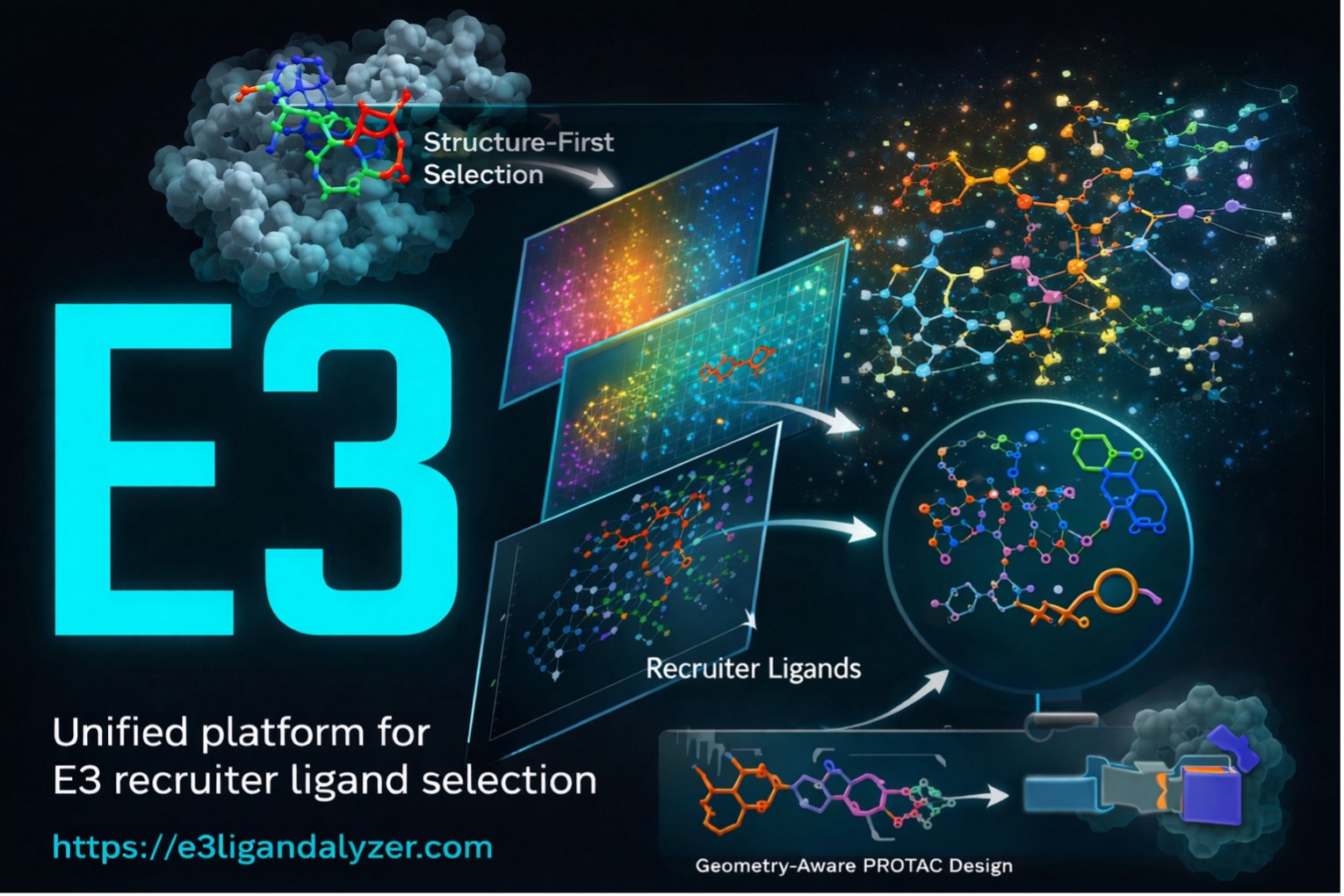
Platform overview. E3 Recruiter Ligandalyzer connects experimentally resolved recruiter complexes to
geometry-aware PROTAC design workflows, helping users move from ligase and recruiter inspection into linker-ready
assembly decisions.
Quick answer: how do you choose an E3 recruiter?
Identify E3 ligases that are biologically plausible in the intended disease, cell, or tissue context.
Inspect recruiter-bound structures instead of choosing a recruiter only because it is familiar.
Compare recruiter ligands by molecular weight, LogP, QED, scaffold class, and ligase association.
Check whether the recruiter has solvent-exposed atoms that can plausibly support linker attachment.
Compare binding poses and pocket geometry across available structures for the same ligase.
Use expression context as a biological filter, not as a hard ranking rule.
Export the selected recruiter into PROTAC Builder with a defined attachment atom.
Test multiple linker and warhead combinations downstream.
Why E3 recruiters matter
Ternary complex geometry
The recruiter determines how the ligase is oriented relative to the POI and therefore shapes the ternary interface you are trying to create.
Degradation profile
A recruiter with acceptable binary binding can still fail as a degrader handle if its exit vector or bound pose produces poor ubiquitination geometry.
Selectivity
Changing the ligase or recruiter scaffold can shift cooperativity, isoform preference, degradation depth, and off-target behavior.
Property burden
Recruiters contribute meaningful molecular weight, lipophilicity, polarity, and hydrogen-bonding features to the final degrader scaffold.
Attachment feasibility
Some recruiters expose clearer linker handles than others, and those exit vectors are often obvious only in the bound 3D context.
Biological context
Ligase expression and cellular context can support or weaken a recruiter hypothesis, especially when moving beyond habitual CRBN or VHL starting points.
Caution: do not choose an E3 recruiter only because it is common. Choose it because its binding mode,
exit vector, scaffold, expression context, and downstream geometry make sense for the target and cell system.
What E3 Recruiter Ligandalyzer adds
E3 Recruiter Ligandalyzer is designed as a structure-first, ligand-centric platform for recruiter selection before
degrader assembly. Instead of treating the recruiter as a single static fragment, it helps users compare recruiter
chemotypes, binding poses, solvent exposure, scaffold families, and export readiness.
Current platform snapshot
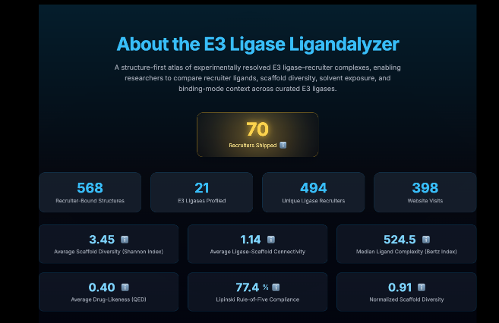
21 curated human E3 ligases, 494 unique recruiter ligands or components, 568 recruiter-bound structures, and 602 curated recruiter-conformation entries.
Scaffold organization
386 unique scaffolds and 419 scaffold superclusters help users move from single recruiters to broader chemotype-level reasoning.
Design-support features
MW, LogP, QED, SASA-style solvent exposure, scaffold diversity, ligand-efficiency-related metrics, and Lipinski compliance are available as context features.
Decision support, not prediction
The platform helps prioritize recruiter candidates and attachment ideas, but it is not presented as a predictive ranking engine for successful degraders.
Figure 1. Overview dashboard for E3 Recruiter Ligandalyzer, showing dataset scale, recruiter
coverage, scaffold diversity, and integration-oriented summary metrics.
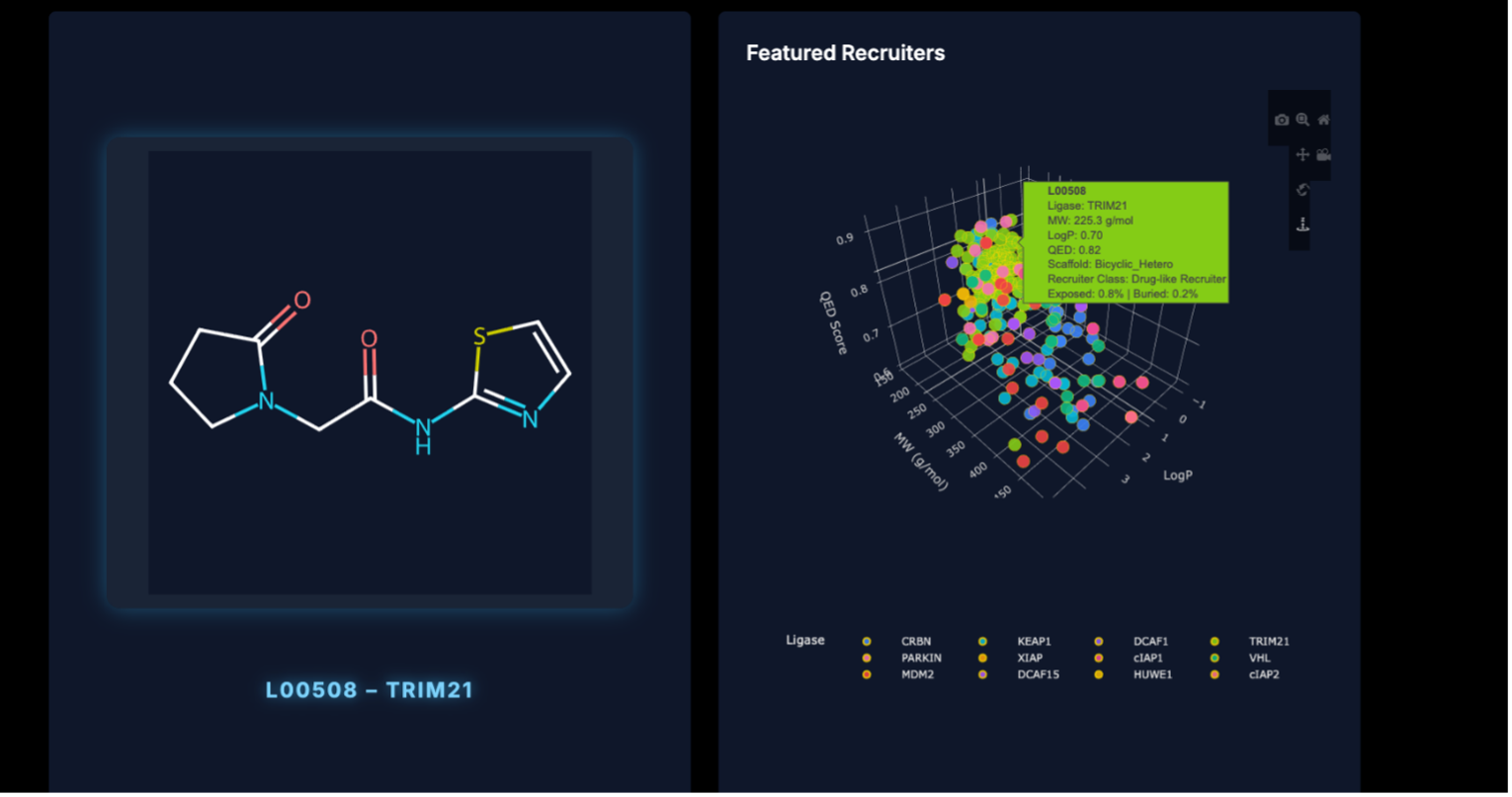
E3 recruiter ligand chemical space
Figure 2. Interactive recruiter chemical-space view showing how recruiter ligands can be compared
by molecular weight, lipophilicity, QED, scaffold class, and ligase association.
The explorer view helps users compare recruiter ligands in chemical-property space before committing to one ligase
family or chemotype. That is useful because the right recruiter is rarely determined by a single metric.
Compare MW, LogP, QED, scaffold class, and recruiter class across ligases.
Look for crowded familiar clusters and underexplored regions that may still be tractable.
Use ligand-level inspection to move from global chemical space into a specific recruiter hypothesis.
Remember that a compact recruiter with attractive descriptors can still fail if its geometry or exposure is wrong.
Design takeaway: chemical space is a prioritization layer. It helps you compare recruiter options,
but it becomes useful only when paired with bound-structure inspection.
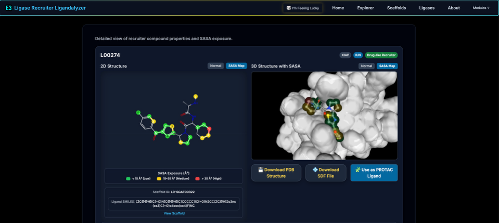
Recruiter-level pages combine 2D chemistry with 3D protein-ligand context so users can check whether a proposed
exit vector is actually accessible in the bound pose.
Prefer solvent-exposed atoms when considering recruiter-side linker attachment.
Avoid modifying atoms that drive key binding interactions unless SAR or structural evidence supports the change.
Compare SASA-style exposure metrics with the surrounding pocket geometry rather than trusting one numeric feature alone.
Use the structure view to decide whether the apparent 2D exit vector is blocked, buried, or sterically awkward in 3D.
Practical rule: a good recruiter attachment site should be plausible on paper and plausible in the
bound structure. If those two stories disagree, trust the bound pose first.
Figure 3. Recruiter-level analysis with 2D chemistry, 3D binding-pocket context, and solvent
exposure features relevant to linker attachment and export.
How to choose an E3 recruiter across ligases
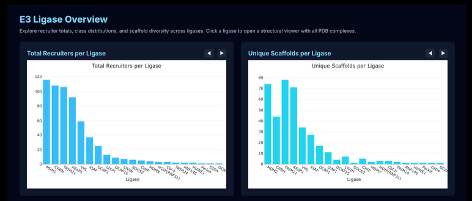
Figure 4. Ligase-centric overview comparing recruiter counts and scaffold diversity across E3 ligases.
Some E3 ligases have many recruiter structures and many scaffold families, while others remain sparse. That does
not automatically make the most populated ligase the best biological choice, but it does change how much design
information you can work with.
More structures usually mean more confidence in pose comparison and attachment-site reasoning.
More scaffold diversity means more chemotype options when one recruiter class adds too much burden or exposes the wrong vector.
Lower-coverage ligases may still be attractive if the biology or expression context is compelling.
E3 choice should combine structural coverage, recruiter chemistry, expression context, target biology, and downstream modeling.
Structure-first recruiter selection inside one ligase family
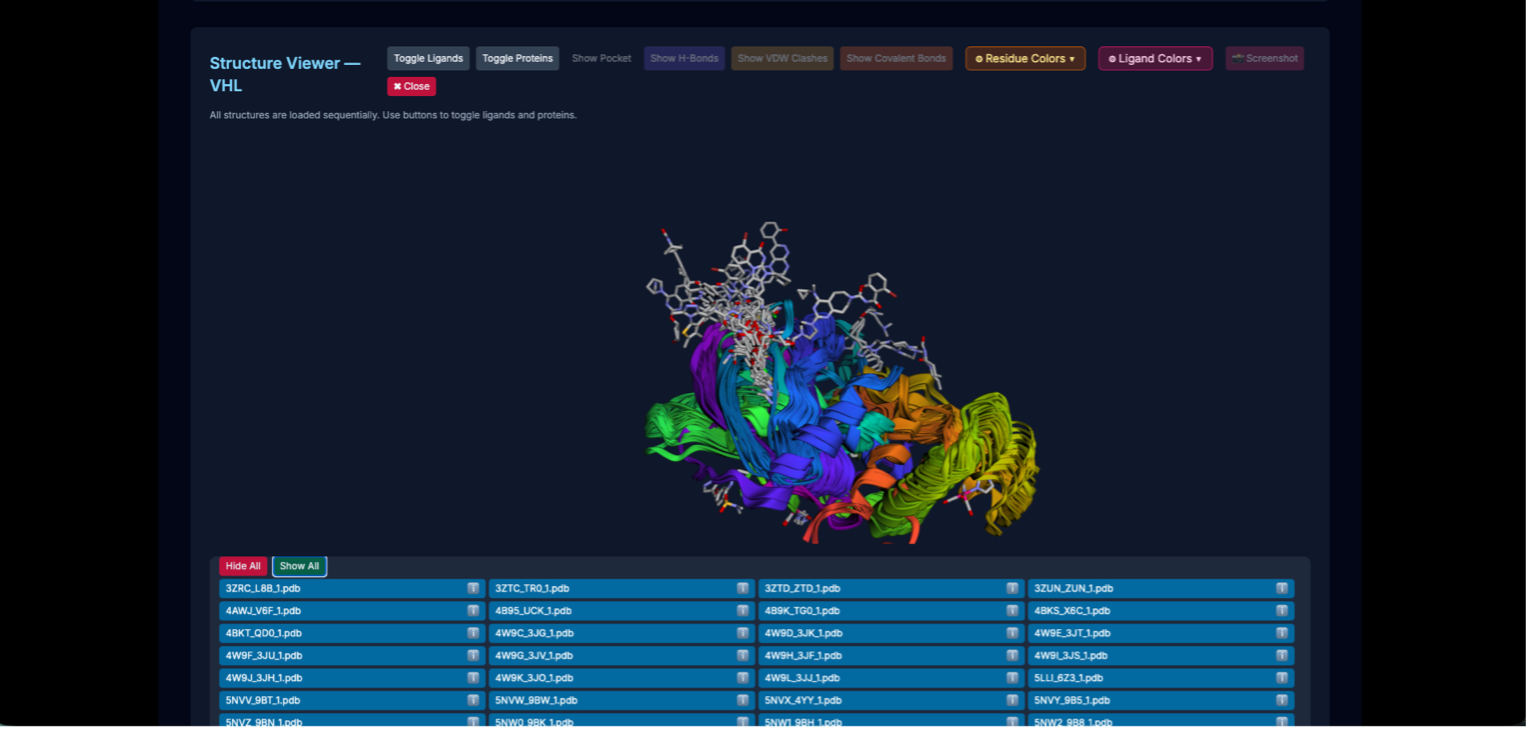
The aligned structure viewer helps users compare multiple recruiter-bound complexes for a single ligase, which is
where geometry-aware recruiter selection becomes especially useful.
Compare binding orientations, conserved interactions, and ligand placement within the same pocket.
Toggle ligands, proteins, pocket views, and interaction overlays to understand steric constraints.
Use these overlays to compare how different recruiters expose different vectors even when they bind the same ligase.
Design takeaway: if two recruiters bind the same ligase but expose different vectors, they may
produce very different ternary complex geometries after linker attachment.
Figure 5. Aligned structure viewer for comparing recruiter binding modes, pocket geometry, and
exit-vector orientation within one E3 ligase.
Scaffold diversity across E3 ligases
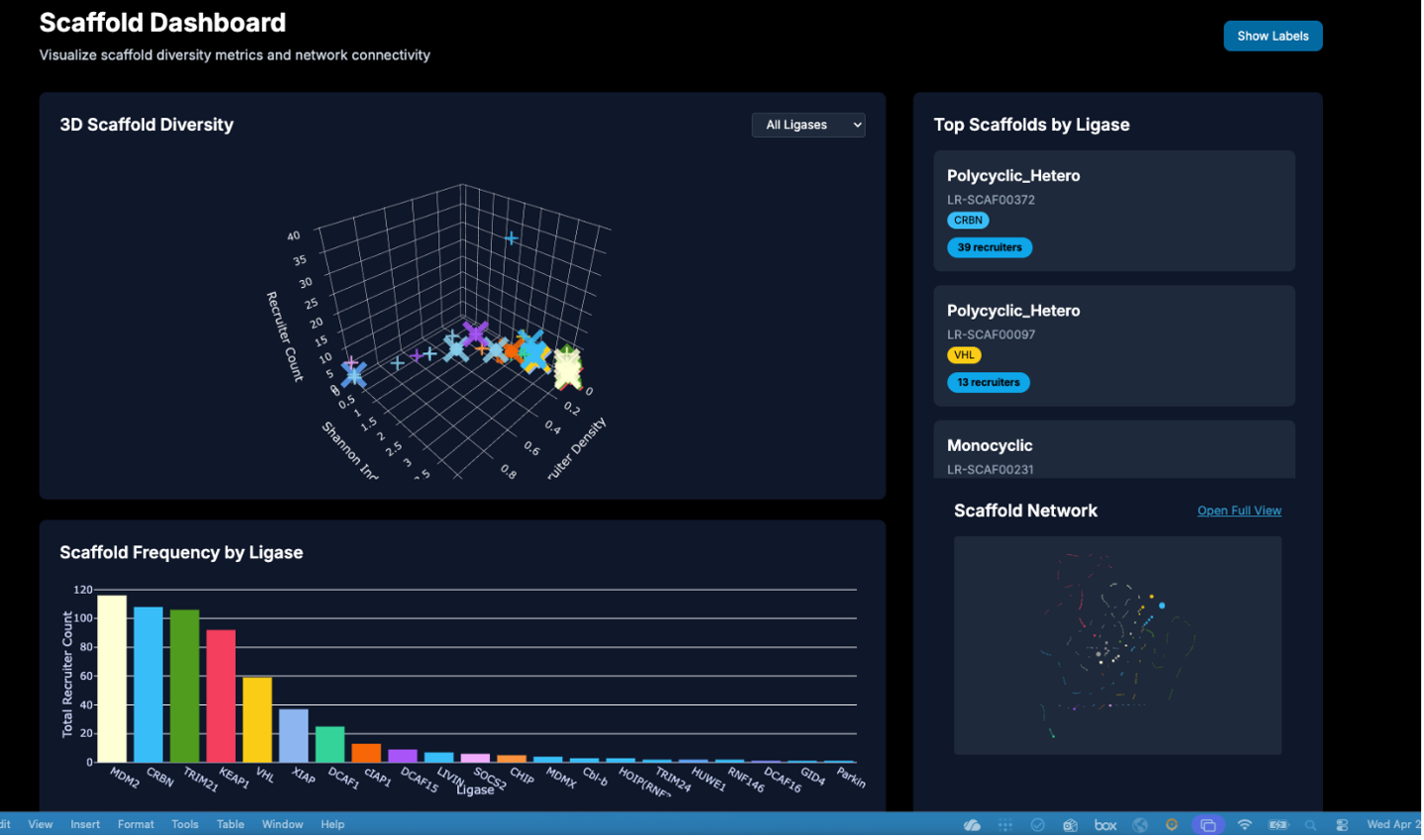
Figure 6. Scaffold Dashboard showing recruiter scaffold diversity, scaffold frequency by ligase,
and scaffold-ligase connectivity.
Scaffold analysis helps users reason about recruiter families instead of single analogues. That is useful when a
familiar recruiter binds well but carries the wrong properties, exposure pattern, or synthetic burden for a
downstream degrader program.
Expression context matters because degrader activity depends on the recruited E3 being present in the relevant cellular
setting. E3 Ligandalyzer adds expression views as a contextual layer rather than a rigid pass-fail ranking system.
Current expression snapshot
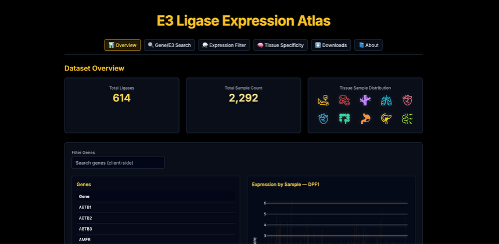
Expression profiles cover 614 human E3 ligases across 2,292 tissue samples in the current atlas-oriented platform view.
How to use it
Use expression to screen for broadly expressed ligases, tissue-enriched ligases, or obvious biological mismatches before committing to recruiter optimization.
What it is not
Expression should not be treated as an automatic winner-take-all score. Recruiter chemistry, bound geometry, and target biology still matter.
Expression workflow
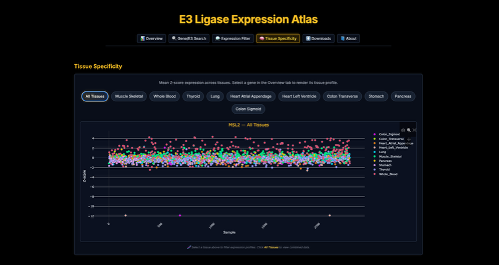
The module supports overview inspection, gene or ligase search, expression filtering, and tissue-specificity visualization for downstream decision support.
Figure 7. Expression atlas overview used to add biological context to E3 ligase selection.
Figure 8. Tissue-specific expression visualization for comparing E3 ligase expression patterns across tissues.
Export recruiters to PROTAC Builder
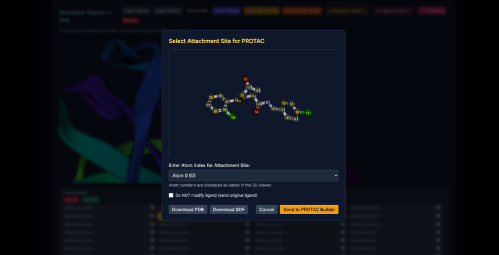
E3 Ligandalyzer is intentionally upstream of PROTAC Builder. Once a recruiter is selected, users can choose an
attachment atom and export the recruiter into PROTAC Builder as an editable 2D structure for linker attachment
and degrader assembly.
Preserve continuity between recruiter inspection, exit-vector selection, and linker design.
Carry the selected attachment point forward instead of re-deciding it after assembly has already started.
Use PROTAC Builder to pair the recruiter with warheads, enumerate candidate linkers, and prepare downstream handoffs.
E3 Recruiter Ligandalyzer is an active Schurer Lab platform for structure-first E3 recruiter ligand exploration.
Dataset counts and feature availability may change as the platform is updated.
This page is intentionally written as an internal platform guide rather than a formal literature citation. It reflects
the current Ligandalyzer tool.