Descriptor and property filtering
Fast first-pass triage for MW, cLogP or logD, HBD/HBA, TPSA, rotatable bonds, charge, and basic developability risk. Useful early, but it does not prove ternary formation.
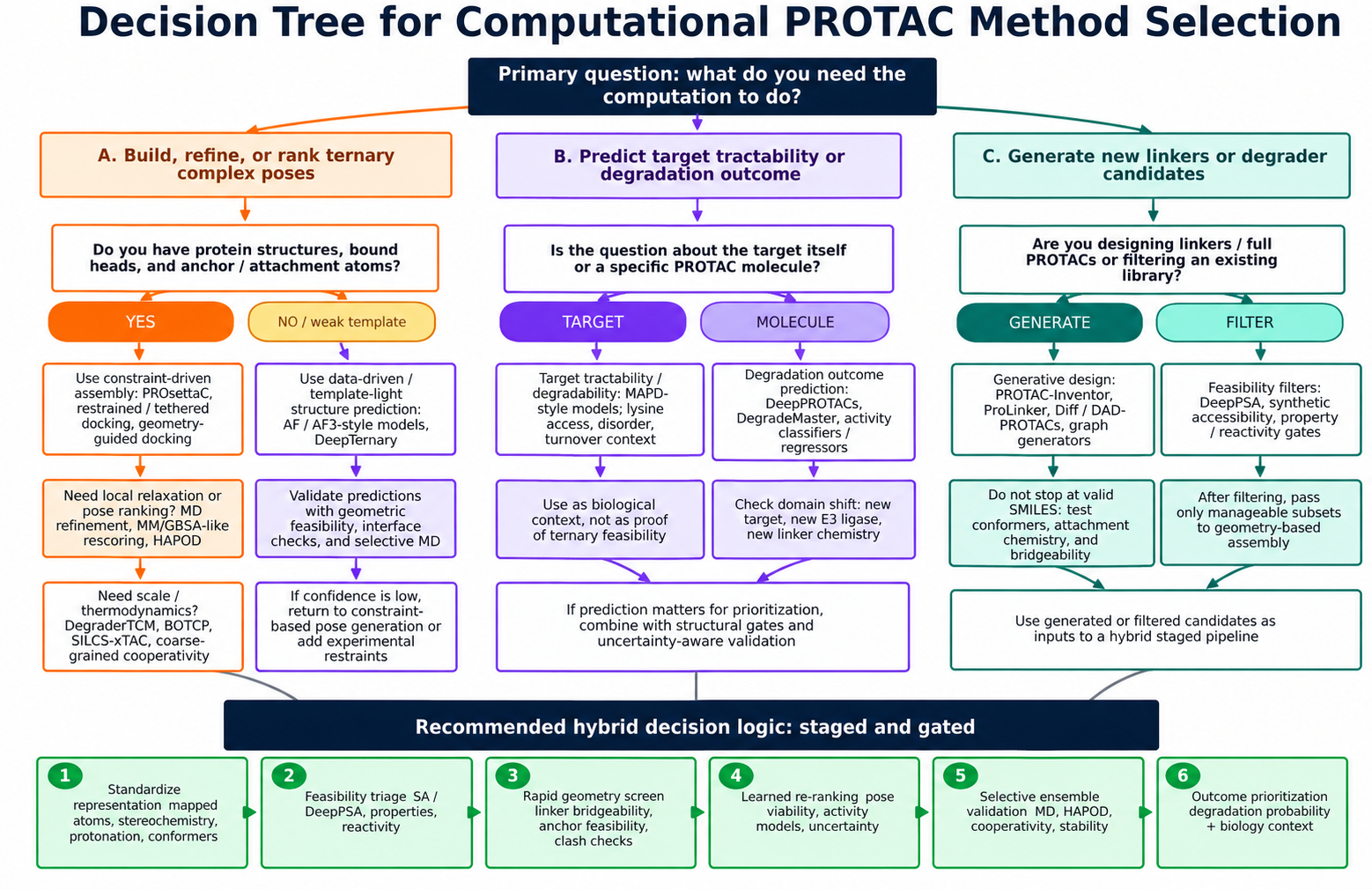
PROTAC Builder outputs are starting points for deeper computational and experimental decision-making. Once a candidate degrader is assembled, downstream modeling asks whether the molecule is chemically valid, geometrically plausible, bridgeable in 3D, compatible with a target-E3 ternary complex, and worth prioritizing for synthesis or biological testing.
The strongest workflows move in stages: preserve the right metadata, screen for obvious feasibility issues, build ternary-complex hypotheses, refine only the most credible poses, and interpret every score as one layer of evidence rather than a guarantee of degradation.
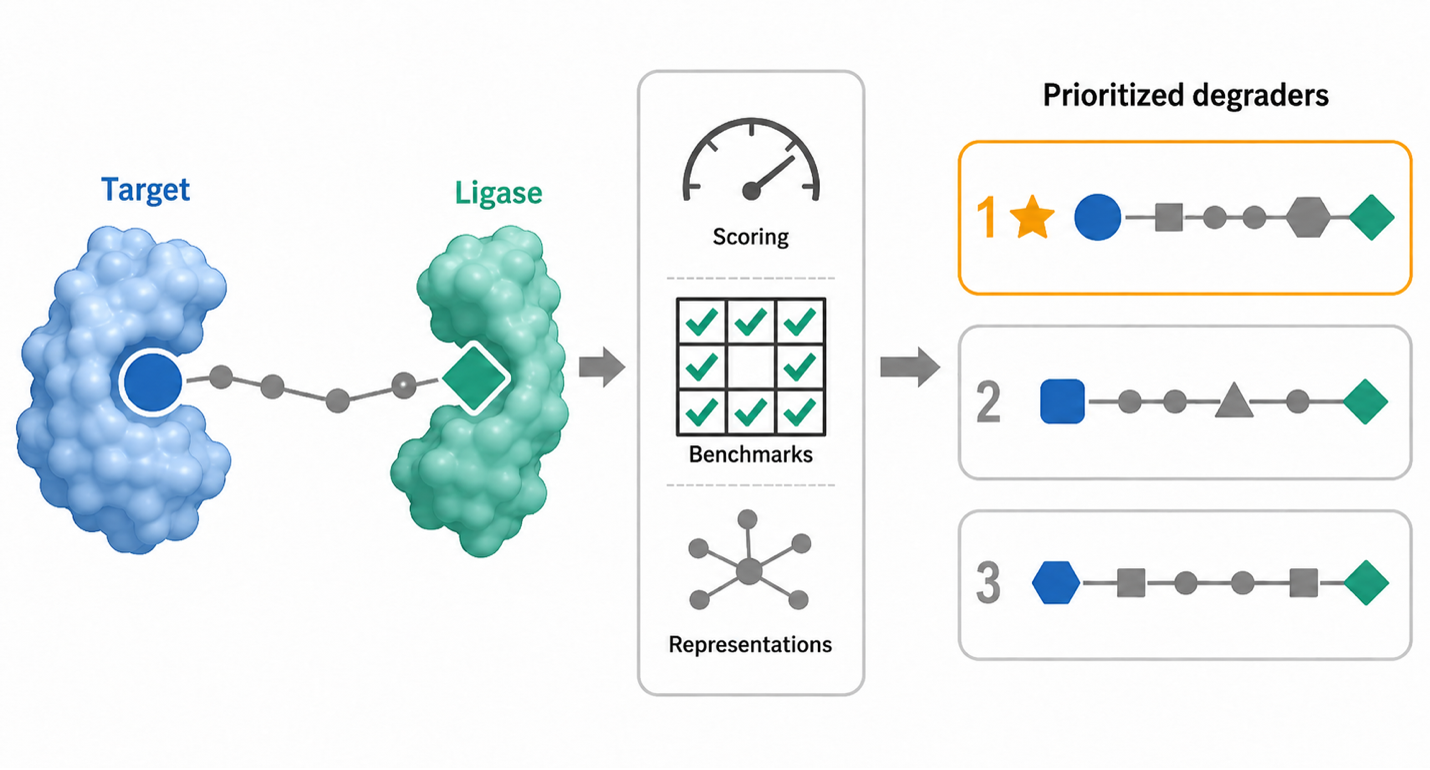
Downstream modeling starts once a candidate has been assembled and exported with enough chemical and structural context to support reproducible 3D evaluation.
Downstream workflows are only as reliable as the handoff. Preserve enough chemistry and metadata so the molecule can be reconstructed, interpreted, and benchmarked without guesswork.
{
  "protac": "assembled structure",
  "warhead_anchor_atom": "documented",
  "recruiter_anchor_atom": "documented",
  "component_boundaries": ["warhead", "linker", "recruiter"],
  "stereochemistry": "documented",
  "protonation_notes": "documented when known",
  "target_structure": "PDB or model reference",
  "e3_structure": "PDB or model reference"
}Fast first-pass triage for MW, cLogP or logD, HBD/HBA, TPSA, rotatable bonds, charge, and basic developability risk. Useful early, but it does not prove ternary formation.
Tests whether anchors and exit vectors can plausibly be connected in 3D before expensive docking or MD. Strongly dependent on correct anchor definitions.
Builds POI-PROTAC-E3 poses under distance or linker constraints. Useful for structure-first design, but sensitive to sampling and scoring.
Uses anchor atoms and linker constraints to guide Rosetta-based ternary modeling. Strong when binding modes are known; brittle when anchors or linker hypotheses are wrong.
DegraderTCM-style lightweight assembly and minimization support rapid screens, but may miss subtler protein-interface rearrangements.
Relaxes poses and tests local stability for prioritized candidates. Useful, but expensive and force-field sensitive.
HAPOD-style or short-MD stress tests help rank pose persistence rather than just minimized snapshots. Requires careful setup and interpretation.
SILCS-xTAC-style approaches evaluate favorable linker or interaction regions across ensembles and can add field-based reasoning to pose review.
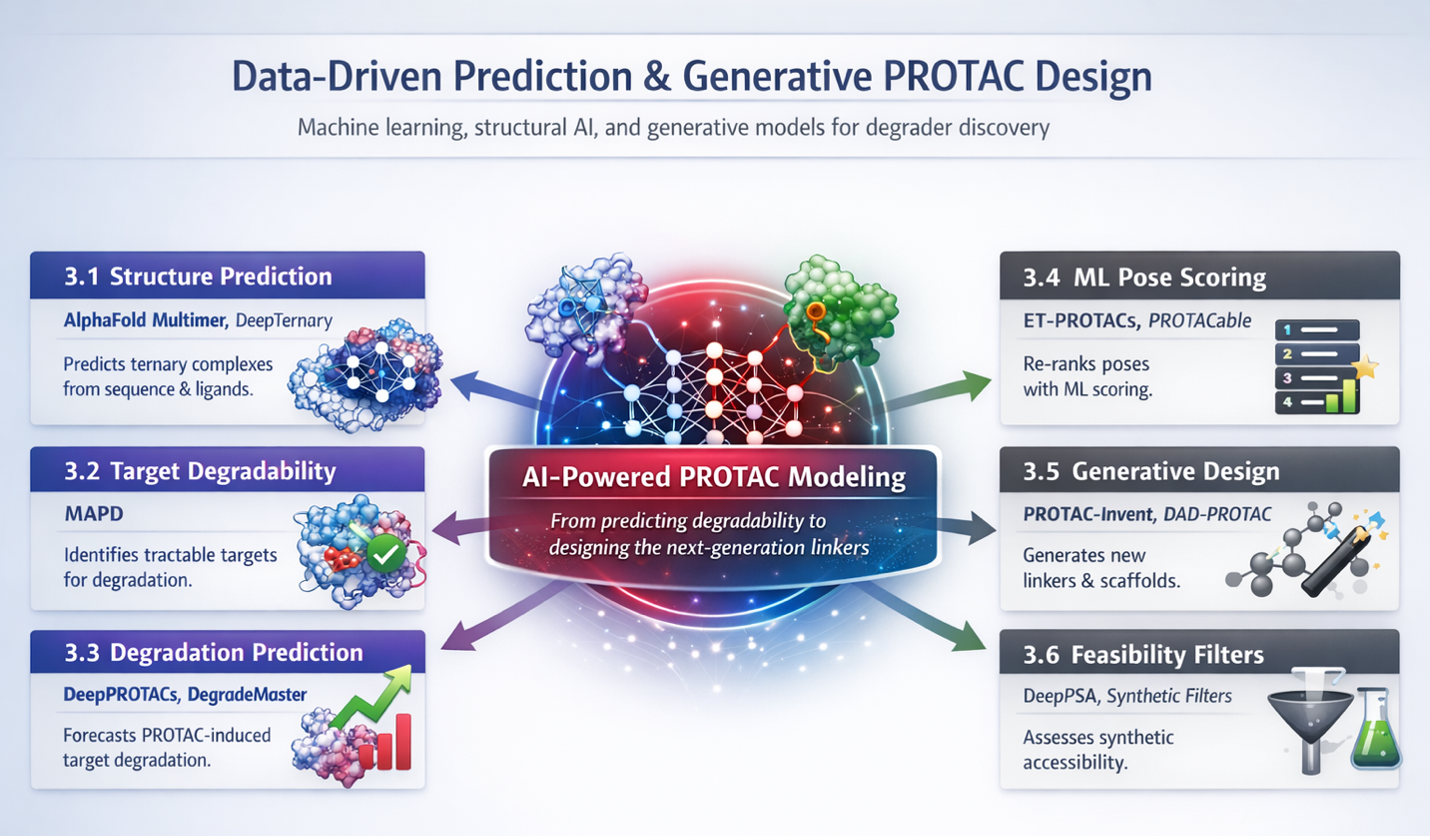
DeepPROTACs, DegradeMaster, ET-PROTACs, PROTACable, and related models can prioritize larger sets quickly, but only within their training domain.
PROTAC-Invent, ProLinker, DAD-PROTAC, diffusion, and graph generators can propose new candidates after failure analysis, but all outputs need chemistry and geometry filters.
Before heavy modeling, check whether the assembled candidate is chemically valid and carries a plausible property burden for the intended context. PROTACs often live beyond classic Rule-of-Five space, so these filters are best used as risk indicators rather than hard pass or fail rules.
This is where large enumerations and generative outputs should be pruned before expensive structure-based work. DeepPSA-style synthetic accessibility or related feasibility modules can support this stage, but they should be interpreted as triage signals rather than final answers.
A 2D PROTAC can look perfectly reasonable while being impossible or highly strained in 3D. Bridgeability checks ask whether the linker can plausibly connect the warhead and recruiter anchors across candidate protein orientations without buried paths, impossible distances, or severe clashes.
Use anchor-aware and exit-vector-aware reasoning before expensive ternary-complex modeling.
Review constraintsCompare flexible, rigid, and polarity-balanced linker hypotheses before final handoff.
Review linkers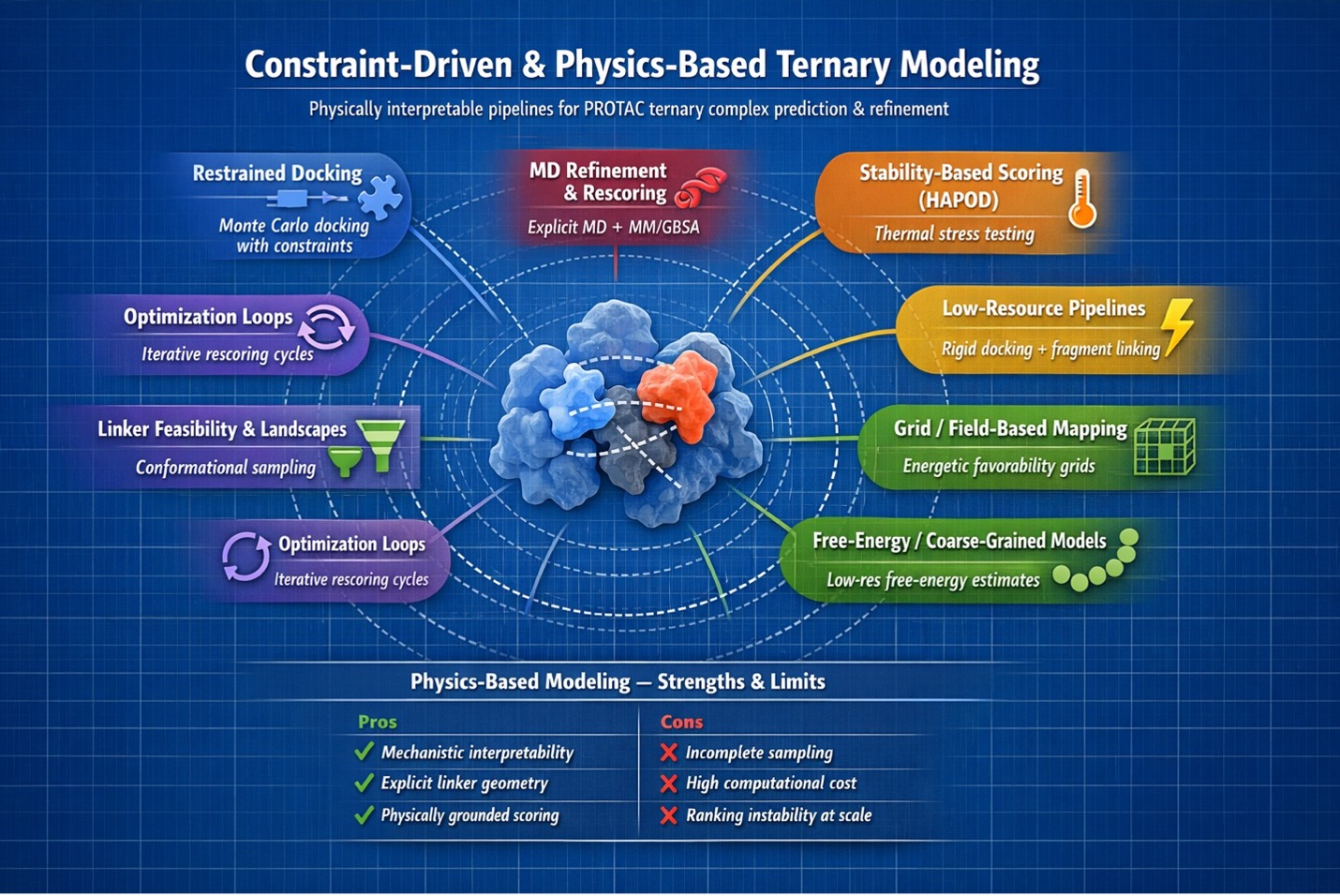
Uses geometric restraints to keep the PROTAC linker compatible with both bound ligands. Useful for POI and recruiter pairs with known structures, but it needs decoys and ranking checks.
Use anchor atoms and distance constraints to guide Rosetta sampling. Especially useful when the input binding modes are reliable and you want interpretable linker-geometry hypotheses.
Faster and lighter ternary modeling for larger candidate sets. Strong as a triage layer, but not definitive for subtle protein-interface rearrangements.
Restrict evaluation to linkable protein-protein orientations and help explain why some linker lengths, vectors, or chemotypes fail before deeper refinement.
Once you have a smaller set of plausible poses, use refinement and ensemble methods to test whether those poses hold together under more realistic conditions.
Energy minimization, explicit-solvent MD, MM/GBSA-style rescoring, HAPOD-style dynamic stress testing, short-MD persistence checks, ensemble evaluation, and SILCS-xTAC-style field-based scoring.
A stable pose does not guarantee degradation. Cell context, E3 expression, lysine accessibility, permeability, ubiquitination geometry, and assay conditions still matter.
Downstream modeling should not rely on one score. The goal is to build a layered argument for why a candidate is worth keeping, not to hide score disagreement.
Learned predictors can help triage large candidate sets after geometry filters. They are most useful when you need throughput, uncertainty-aware prioritization, or learned re-ranking on top of structure-first generation.
Useful for candidate-level degradation prioritization from molecular and protein features.
Useful when spatial arrangement matters and the training data covers similar systems.
Useful for pose-ensemble prioritization or integrative 3D modeling pipelines.
Useful when direct ternary-geometry prediction is the main question rather than classic restrained docking.
Downstream failure analysis should feed back into design. If bridgeability fails, descriptors look poor, or ternary geometry is repeatedly unconvincing, the next step may be a new linker, a different attachment vector, or even a different recruiter or warhead.
PROTAC-Invent-style 3D linker generation, ProLinker-style language-model workflows, DAD-PROTAC, diffusion, and graph-based generators can propose new molecules, but every output still needs chemical sanity, synthetic feasibility, bridgeability, and biological validation filters.
If you want downstream results to be reproducible, report the handoff as carefully as the score.
System definition, protein structures and chain IDs, E3 complex composition, PROTAC representation, warhead-recruiter-linker boundaries, attachment atoms, anchor definitions, and stereochemistry or protonation state.
Conformer-generation protocol, software and versions, random seeds, restraints, scoring settings, decoys or negative controls, and the exact output poses and scores kept for review.
Domain of applicability, failure modes, validation status, and whether the workflow is being used for structure recovery, re-ranking, degradation prediction, or generative redesign.
PROTAC workflows are highly sensitive to attachment atoms, protonation, conformers, construct definitions, and restraint choices, so incomplete reporting undermines comparison across methods.
Use the staged assembly workflow before you ever hand a candidate into downstream modeling.
Read guideReview linker length, rigidity, polarity, and exit-vector tradeoffs before bridgeability analysis.
Review linkersInspect recruiter binding poses, solvent exposure, and attachment sites before ternary modeling.
Explore recruitersGround handoff decisions in anchor-aware geometry and bridgeability reasoning.
Review constraintsSee the broader computational landscape beyond this practical handoff guide.
Read modeling guideCompare and cluster PRosettaC-derived ternary-complex model families with a reproducible DockQ workflow.
Open JARI guideUse benchmark-ready reporting and task-specific metrics when comparing methods or publishing results.
Open benchmarking guideSupport scripted and batch-oriented handoffs for larger enumerations and reproducible pipelines.
Open API BuilderUse case-study pages to show what an end-to-end builder-to-modeling workflow can look like.
View examplesThis page is based in part on the Schürer Lab perspective manuscript From Ternary Modeling to Predictive PROTAC Design: A Computational Perspective. It is intended as an educational workflow guide for downstream computational handoffs.
The focus here is practical workflow design: what to export, what to check first, when to use heavier physics, when to use learned prioritization, and how to document the whole process so results remain interpretable and reproducible.